Showing posts with label Costumes. Show all posts

Friday, May 20, 2016

SCR Artisans: Building a Little Structure

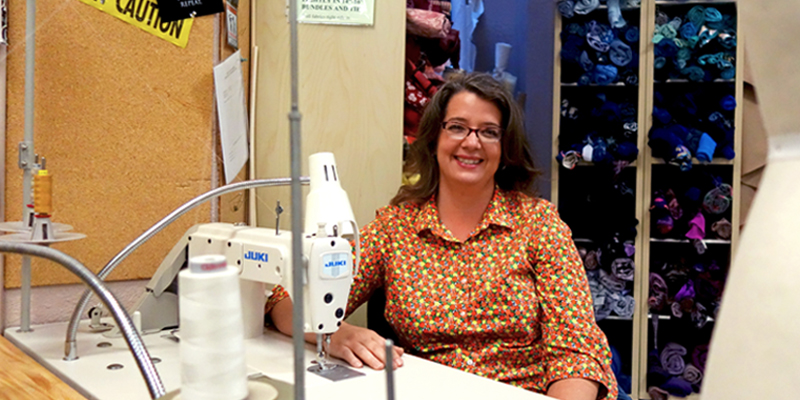
South Coast Repertory's Cutter/Drapper, Catherine Esera

Amadeus rendering by costume designer Alex Jaeger
When a costume designer meets with the show's director, they talk about the concept, look and needs for the production. When the final costume designs are turned in and approved, renderings are made and sent to South Coast Repertory's Costume Shop.And then, the next phase of building costumes happens.

So, how does an illustration go from page to fully realized and functional costume on stage? Catherine J. Esera, South Coast Repertory's cutter/draper, is a part of the team that makes it all happen. Esera first joined SCR as an overhire for the Costume Shop in 2003. Eventually, she was hired full-time as the cutter/draper in 2009.

"When I explain to people about what I do, my first step is to correct them: I am not a costume designer," explains Esera. "Then I tell them that once the designer draws the costume renderings and selects the fabrics, I am given those, along with the actors' measurements, and am told, 'Make it happen!'"

Marco Barricelli with Camille Thornton-Alson in a different pannier.
Over seven seasons, Esera has worked with numerous designers, crafted clothing spanning multiple eras and even built costumes that transformed actors into bugs and animals. A few shows have stood out over the years for her.

"In the Next Room, or the Vibrator Play was a huge costume show and my first big build on staff," says Esera. "Pride and Prejudice was fun to work on because of the huge fan base behind that title and because Paloma Young's designs were beautiful! Most of our Theatre for Young Audiences shows are a blast to work on. They're fast builds, but to pull off the fantastical with such unique materials is very challenging and fun."

For Amadeus, structure rules the designs, because many characters wear corsets, bum rolls and panniers. Esera was tasked with creating a pannier hoop skirt, which is a structure worn underneath women's skirts during late 18th century to create the overall shape and silhouette popular during that time. The pannier hoop is distinctive for its oval shape, rather than being formed in a circle.

Esera takes us inside her process with a step-by-step guide to building a pannier hoop.

Step 4
Step 1
"It's important to use several different sources for period research. I use  research as a guideline, rather than a law book. Since modern bodies are shaped differently than those of the past eras, putting all of the period seams in all the same spots just won't work. I also have to consider all the actor's physical needs, quick changes and maintenance for the performers' costumes. One of my sources was a book in our Costume Shop about Colonial Williamsburg clothing, which had photos and a pattern for a pannier hoop skirt. I read the description many times and scrutinized each photo. Then, I looked in other books and online for more photos and paintings of the same type of structure."

Step 2
"I scaled up the pattern from the book. Then, I took the "original" pattern and made it the proper size for the actor. I also made a few changes so it would be more theatre friendly—alteration points, added length, etc. I can never make anything just the way the books show. There's always some hot-rodding to be done!"

Step 5
Step 7
Step 8
Step 3
"I washed, dried and pressed the natural linen that was chosen for our piece. I cut out all but the yoke from the linen. Since the yoke had the most changes, I cut those pieces out of muslin to make it easier for any possible adjustments during the first fitting."

Step 4
"Then, I sewed the cut fabric together, including the padded side openings and the drawstring waist."

Step 5
"Amy Hutto, our Costume Shop manager, and I bought lengths of natural round reed at a local reed and cane store. To make the frame to shape, I traced out my shapes from the scaled/graded pattern onto a piece of plywood and hammered nails into the plywood at about 1" apart. There are four hoops in the skirt: one small, two medium and one large."

Step 6
"One at a time—because I've never done this before—I soaked each reed for a minimum of three hours using a rain gutter that I borrowed from our Scene Shop."

Step 7
"I removed the reeds from the water and slowly bent it around the frame of the nails. The top hoop was the most difficult because it was the smallest and had compound curves."

Step 8
"I let the reeds dry on the frame for several days each."

Step 9
Step 11
"To join the ends of the reeds together, I had to come up with my own method. According to my research, the original period method would have not been suitable for our needs. I used lengths of bamboo that had the appropriate size hollow that would fit around the reed. Too small wouldn't fit, but too big would not be secure enough and would potentially be dangerous for the actor. Since the bamboo was a bit brittle once the reed ends were inserted, I wrapped each piece with gaff tape to help stabilize it."

Step 10
"I threaded the reeds into the linen skirt to build the structure."

Step 11
"Finally, we fit the whole piece on the actor, made the necessary changes to the yoke, cut the modified yoke pieces out of the linen, sewed them onto the skirt and voila! Pannier hoop skirt complete with reed hoops!"

Learn more and get your tickets to Amadeus.

Tuesday, October 20, 2015

A Different Definition of “Dressing for Success”

SCR's Wardrobe Supervisor Bert Henert
WHO'S THAT?

Wardrobe Supervisor: In charge of all costumes once they leave the Costume Shop (where costumes are built) and move to the performance space (Segerstrom or Julianne Argyros stages, and as needed, the Nicholas Studio). Oversees work done by any costume staff on shows to ensure that costumes are ironed, pressed, cleaned and repaired. Checks in on each show to confirm that everything related to costumes is going well. Helps actors with quick changes in general, getting into and out of costumes.

Dresser: Works on a specific show, doing specific jobs, such as costume maintenance, ironing, or steaming.
Bert Henert is backstage at South Coast Repertory, waiting for Beth Henley’s Abundance to start. He’s dressed in black, with a full-length apron that has multiple pockets. The apron is adorned with an array of items including safety pins, two small flashlights, bobby pins, a tape measure, pens, a small notepad, small scissors, tissues, bandages, zipper wax, an eyeglass repair kit, glass cleaning cloths, shoe horn, tweezers, sewing needles, thread and hand sanitizer.

He is ready for anything in his role as SCR’s wardrobe supervisor, which includes helping actors with costume changes during performances. Everything needs to run smoothly, whether a costume change takes five minutes or needs to happen in 15 seconds.

But Henert’s job goes beyond those backstage changes during a show. Once costumes have been built in SCR’s Costume Shop, the pieces move to one of the theatre’s performances spaces (in the case of Abundance, on the Segerstrom Stage), where Henert manages them.

Angela Balogh Calin designed the period costumes for Henley’s American West tale of two mail-order brides in the 19th century. Included are frock coats, working clothes, bowler hats, bonnets, fancy dresses, bustles, corsets and petticoats, and on each piece, an array of fine details—both seen and hidden.

Henert stresses that costumes are not clothing—they don’t come off a store rack ready to be worn by an actor. Even costumes for contemporary plays have special treatment or elements to ensure that they will meet the needs of the production. For example, fabric may be painted or specially dyed or have other finishing or quick-change elements built in. And costumes need to withstand wear and tear from up to three-dozen performances. Day-to-day, costumes are maintained through cleaning, maintenance and repairs. The gowns in Abundance need special attention since they may not necessarily be wash-and-wear.

Paige Lindsey White and Daniel Reichert in Abundance.
Then, it’s on to the matter of changing costumes during a performance. It takes a lot of pre-planning and, once rehearsals start on stage, coordination between the Costume Shop, stage management and Henert to ensure that this element of the production goes smoothly.

“The designers and our Costume Shop find the best way to be true to the look of the period, but to hide the use of modern elements like zippers or snaps, which are much faster to use than buttons,” he says.

The backstage wardrobe area includes a number of things to help the actors. A rolling rack, baskets, chairs and shelves help him prepare things for easy access. Lots of shelves in this case because Abundance has numerous shoes and hats. A standing mirror is one last element so that actors can do a quick check before returning to the stage.

THREE QUESTIONS

What are you watching now?
“‘Homeland’ and ‘Nurse Jackie.’ These are two shows that I’ve been meaning to watch and I’m a huge Eve Best fan!” Next up for him to watch: “The Affair.”

What do you do outside of theatre?
“I garden. I like working with plants and being outdoors. I’m trying to get into long-distance hiking nad have a goal to hike the John Muir Trail one day.”

What’s your beverage of choice?
“Tea, herbal or black iced teas. Right now, I’m sipping on a blood-orange black iced tea. It’s great!”
Henert’s non-performance-time work space includes washing machines and dryers, an ironing board with a built in steamer and vacuum, a sewing machine and lots of extra supplies. For him, this command center is right where he wants to be—he thrives on the creativity, problem-solving, organization and imagination—in short, the theatre.

Henert grew up in Wisconsin and was drawn to theatre at an early age when he took acting classes and worked in productions at Children’s Theatre of Madison. He still remembers his first production: Federico García Lorca’s Blood Wedding. (“Right? For kids!” Henert chuckles. “But it was fun and we were involved in the whole backstage process, helping out and getting to see everything.”)

He studied theatre and costume design at the University of Southern California and came to SCR seven seasons ago. He loves the artistry and inventiveness that is woven into the dramatic arts.

“I love how costumes help create a character,” he says. “And there is so much fabric to play with!”

SCR is home for Henert. He enjoys working with the many actors, directors, designers, stage managers and others, including the theatre’s regular staff.

“We do such great work here and it’s a great place to learn and to be a part of,” he says.

And the solution to the 15-second costume change? The actor wears two costumes—taking off the outer garment, revealing the costume underneath for the next scene Presto, change-o—it’s the magic of theatre.

Learn more about Abundance and buy tickets.
Photos by Ben Horak.

Tuesday, October 13, 2015

Artisans of SCR: Crafting the Rough Edges of "Abundance"

Abundance costume designer Angela Balogh Calin in SCR's Costume Shop. Photo: Ben Horak/SCR.
A pirate, a civil war solider and a grasshopper all have something in common. And it’s not a bad punch line. Their commonality is the mastermind behind their clothes, their style and their looks—all crafted by costume designer Angela Balogh Calin.

Calin has designed for more than 50 productions at South Coast Repertory. The list could go on for days: from last season’s Peter and the Starcatcher to Crimes of the Heart to Noises Off and more than a dozen Theatre for Young audiences productions, she’s gone from contemporary times to the 1800s to fantasy. The one place she hasn’t yet gone with her designs at SCR? The Wild West.

Until now, that is. Her time is currently being filled with fittings and finding the right pieces for costumes that she's designing for Abundance by Beth Henley, with first previews starting Oct. 16. In Abundance, the time is the late 1800s and two mail-order brides head west to the Wyoming territory in hopes of finding a more complete life. Calin couldn’t be more thrilled to be designing a western this time around. They happen to hold a special place in her heart.

“I am very fond of this period and setting for more than one reason,” says Calin. “One of my most vivid memories from growing up in Romania was watching westerns with my father. We were both mesmerized by the scenery, the harshness of life and the resilience of the human spirit. Even now, one of my favorite places to travel to is the Southwest with its amazing colors, views and endless blue skies.”

As she began work months ago for this production, Calin looked for inspiration in many places, including television. Pulling from some of her personal favorites, “Hell on Wheels” and “Deadwood,” she found the beauty of the Wild West in its rough worn edges.

Calin working in SCR's Costume Shop
“Both series were a great source for my research," she explains. "They seem to truthfully convey the harshness of life in the Wild West. At the time, clothes were expensive and ordinary people could not afford more than a few. A hat or a pair of boots would have to last for a very long time, a ribbon or a yard of lace would be a cherished accessory for a young woman.”

Calin has been scouring SCR’s collection of stored costumes to find the perfect pieces. She loves the history that previously created costumes hold. “I always enjoy recycling clothes or costumes because I believe they have a past life and stories to tell. Just like people. Past experiences add a new dimension and excitement to life,” she says.

Outside of SCR’s collections, Calin also has been looking online for companies that specialize in recreating vintage clothing. She’s even been able to find and alter modern clothing to fit the needs of the production. And, of course, she’s had a few pieces created specifically for the show, “This play needs authentic-looking clothes in order to successfully covey the journey of the two couples,” she says. “We only built a few costumes, mainly the ones that we need doubles of and two of the more elegant ones.”

With technical rehearsals starting today and performances just around the corner, Calin keeps in mind what might make a costume design stand out, “Have you noticed those times, when watching an old movie, that the design looks so outdated and it’s almost sad? And then, there are the movies that always are as exciting as the first time you watched them! I think successful costume designs are about creativity, imagination, humor and the courage to speak about the characters they are made for.”

Learn more and buy tickets now.