Friday, May 20, 2016

A Very “Punny” Play: "The Light Princess"

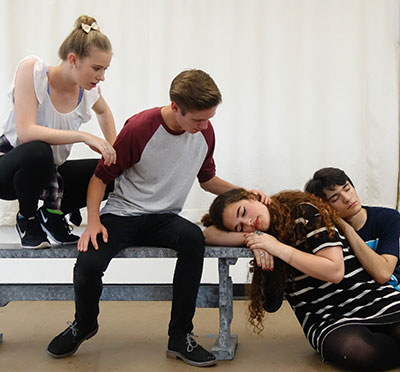
Joel Gelman, Nicholas Mongiardo-Cooper and Emily Eiden in The Light Princess.
The title of The Light Princess contains a pun, a humorous play on words in which a single word has multiple meanings at once. In this example, “light” refers to both a lack of gravity (physical) and a lack of seriousness (emotional).

Here are a few other examples of puns. In each example, circle the word that is the pun. (In the first question, this word has been bolded for you.) This word has two meanings, one in each column of answers. In the blanks next to the questions, write the letters that correspond with both definitions of the circled word.
  1. What did the road say to the bridge? You make me cross. ____f____, ________
  2. Pencils could be made with erasers at both ends, but what would be the point? ________, ________
  3. The tale of the haunted refrigerator was chilling. ________, ________
  4. A giraffe is the highest form of animal life. ________, ________
  5. A man rushed into the doctor’s office and shouted, “Doctor! Doctor! I think I’m shrinking!” The doctor calmly responded, “Now, settle down. You’ll just have to be a little patient.” ________, ________ (Note: there are actually two words in this sentence that are puns—“little” can mean both small and a bit. Look for the meanings of the other pun in the sentence.)
  6. I was struggling to figure out how lightning works then it struck me. ________, ________
  7. A three-legged dog walks into a saloon in the Old West and announces: “I’m looking for the man who shot my paw. “ ________, ________
  8. I saw a sign that said falling rocks, so I tried and it doesn’t. ________, ________
  9. Q: What travels faster, hot or cold? A: Hot, because you can always catch cold. ________, _________
Answers: Column 1
a. frightening, scary
b. to hit, to collide
c. willing to wait
d. a mild illness characterized by a runny nose and sore throat
e. tallest
f. to pass from one side of something to the other
g. to be exciting or awesome
h. the purpose or reason for something
i. an animal’s foot
Answers: Column 2
j. father
k. to occur to someone, to spring to mind
l. the tip or sharp end of something
m. cold, freezing
n. a lack of heat
o. most developed or complex
p. stones
q. a person receiving medical treatment
r. angry or irritated
Where do fairy tales come from? Find out in this BBC Culture article.

Answers: 1. Cross (f, r); 2. Point (h, l); 3. Chilling (a, m); 4. Highest (e, o); 5. Patient (c, q); 6. Struck (b, k); 7. Paw (i, j); 8. Rocks (g, p); 9. Cold (d, n)

Monday, May 16, 2016

Words by Peter Shaffer, Music by Mozart, Production by SCR

On May 13, the glorious music of Wolfgang Amadeus Mozart wafted from stage to terrace as theatregoers—their rousing ovation ended—gathered at the Cast Party for Peter Shaffer’s Amadeus, the final production of the season.

To put the play in historical perspective, Amadeus opened the 1983-84 season at South Coast Repertory to rave reviews. This revival, more than three decades later, marks another auspicious occasion—SCR’s 500th production.

At the celebratory party, golden balloons, shaped as 500s, flew above while below, partygoers congratulated the actors—who had shed their wigs and Classical costumes, donned 21st-century outfits and joined the fun.

Everyone agreed that the theatrically splendid Amadeus, with its cast of 14 inimitable players was an impressive choice to end the 2015-16 season.

Honorary Produce Sandy Segerstrom Daniels led the praise, saying: "Amadeus was incredible! The cast performed as though they had been playing these roles for months. I hope to come back and see it again!"


Having trouble viewing the slideshow? Try watching it here.

Friday, May 13, 2016

Up Through the Ranks and Beyond

The phrase, “something for everyone” applies perfectly to SCR’s acting programs which begin with kids in third grade who are new to theatre and keeps on going.

 Mason Acevedo, Jacques C. Smith, Randle Mell, Hal Landon Jr. and Henri Lubatti in Antigone.
At age 13, Mason Acevedo was a student in SCR’s Theatre Conservatory and a member of the Junior Players, where, among other roles, he played Mowgli in Jungle Book. During his years at SCR, Mason also portrayed Peter Cratchit in A Christmas Carol and alternated in the boys’ roles in Antigone and Cyrano de Bergerac.

Then he grew up. Serious about acting by the age of 18, Mason attended the Adult Acting Program. The following summer, he was accepted into the Acting Intensive Program.

Looking back, Mason says, “The Adult Program is a welcoming environment for students at all levels. Not only did it teach me the benefits acting has on your life and relationships, but it created an avenue for me to go into Acting Intensive, which developed my skill and allowed me to grasp the core of my craft. It also allowed me to see my place in the professional world and how I can most efficiently find success in it. Overall, the program is incredibly unique. From the relationships you make, to the things that you learn, it’s something I will always remember.”

Madeleine Bloom didn’t attend the Theatre Conservatory as a child, but she always loved theatre. Somewhere along the way, she realized that there was more to it than she could get in high school. “I began taking adult acting classes at SCR and fell in love with the program, from the teachers to the staff to the amazing people in my classes.”

Then the opportunity arose to audition for the Acting Intensive Program. “When I got accepted, I knew from the first day I was in for an incredible experience. I loved every minute, At the end of the eight weeks, I couldn’t believe all that we had accomplished and all that was still out there to learn. I would recommend this program to anyone interested in the field.”

Learn more about the Acting Intensive Program

A High-Flying Princess

by Kat Zukaitis


Once upon a time, a young princess was placed under a magical curse that could only be broken by the power of true love.

This is that story… sort of.

In The Light Princess, a barren King and Queen turn to the Queen’s sister—a Witch—for help having a child. They are overjoyed when a baby girl arrives, even though she seems unusually cheerful… and unusually light. In fact, she floats! The Witch has taken away the Princess’ gravity, both physical and emotional: she cannot touch the ground, and she cannot feel any truly weighty emotions, such as fear, sadness or love. If the Princess cannot find her gravity before her sixteenth birthday, the Witch will take over the kingdom, and the Princess will remain weightless forever.

Angela Balogh Calin’s costume design for the Princess.
As the Princess’ sixteenth birthday approaches, her parents desperately dream up ways to weigh her down. They try to make her cry, to no avail, for nothing can make the Princess truly sad. The Queen realizes that her own tears stem not from sadness, but from love. Perhaps the thing that will give the Princess gravity is falling in love!
But the Princess doesn’t want to fall in love. She wants to swim in the lake, the one place where she feels the weight of the water. One day, a wandering Prince—who would rather be a musician—hears her splashing and sets out to save her from drowning. Instead of a grateful damsel, though, he finds a furious Princess who wants nothing to do with him. She hates suitors and wants to return to her lake. He’s not a suitor, he insists, and he hates Princesses. But as the two of them fall back into the lake, they also begin a much more terrifying journey—they begin to fall in love. 

Back at the castle, the King announces a suitor competition, promising the Princess’ hand in marriage to any man who can keep her on the ground, even if it means chaining her to the floor. Meanwhile, the Witch bespells the Prince to drain the Princess’ beloved lake—and with it, all the water in the kingdom. There’s only one way to protect the lake, but it may cost the Prince his life. Can the Princess find her gravity—and save the day—before it’s too late?

Angela Balogh Calin’s costume design for the Prince.
Playwright Lila Rose Kaplan and composer/lyricist Mike Pettry adapted The Light Princess from a 19th century fairy tale by George McDonald, adding a few twists of their own along the way. This Princess is no damsel in distress waiting for a rescue; she is a young woman who must rely on her own wisdom to try to save herself, her Prince and her kingdom. Director Casey Stangl calls the play a “fractured fairy tale” for the way it assembles classic fairy tale elements—a witch, a cursed princess, a prince in disguise—and recombines them into a story about growing up and learning the value of sadness as well as joy. For the Princess, the path to adulthood means embracing both tears and laughter as integral parts of the human experience. “It’s an important story for children,” says Stangl, “and also adults!”

For the SCR production, Stangl wanted to find a way to keep the Princess aloft without wires, looking instead for a “theatrical metaphor” for flight. As luck would have it, the literary staff at SCR had recently been in touch with a choreographer and AcroYoga instructor named Ezra Lebank, the Head of Movement at California State University, Long Beach. Stangl went to see a workshop featuring Lebank and two accomplished Cal State Long Beach theatre students, Taylor Casas and Cynthia Price, and knew that she’d found the way to make her Princess fly.

In The Light Princess, Casas and Price play “gravitrons,” using their expertise in dance and AcroYoga to keep the Princess aloft. With their help, and that of choreographer Rebecca Nakano, SCR newcomer Arielle Fishman floats and soars across the stage as the Princess, her feet (almost) never touching the ground. Stangl felt that it was especially important for this story about a young woman’s empowerment to feature other young woman “lifting their sister up,” so to speak. Add in Mike Pettry’s irresistible music, which is sweeping and silly by turns, and this show really takes off!

François-Pierre Couture’s set design for The Light Princess.
Fishman, Casas and Price are joined onstage by Gina D’Acciaro, making her SCR debut as a very sassy Witch, as well as several actors known and loved by SCR audiences: Ann Noble as the Queen, Justin Figueroa as the Prince, Joel Gelman and Emily Eiden as the Wisemen and Nicholas Mongiardo-Cooper, returning for his eighth SCR show, as the King.

SCR audiences will also recognize director Casey Stangl, whose work here includes several TYA productions, most recently The Miraculous Journey of Edward Tulane and James and the Giant Peach; last season’s Venus in Fur; and the upcoming world premiere of The Siegel. Deborah Wicks LaPuma (musical direction), François-Pierre Couture (scenic design), Angela Balogh Calin (costume design), Karyn Lawrence (lighting design) and Jeff Polunas (sound design) round out the creative team, helping to bring this delightfully imaginative—and unconventional—fairy tale with music to life.

Learn more.

Monday, May 2, 2016

'Process Over Product' in SCR's Actor Training

Christopher Huntley (Oberon), Rachel Charny (Titania), Alex Theologides Rodriguez (Bottom) and Jamie Ostmann (Puck) in rehearsal for A Midsummer Night's Dream.
Theatre Conservatory Director Hisa Takakuwa teaches her students to understand the craft of acting as they create their characters, rather than concentrating on the result, which is the show itself. That’s “process over product.” It’s deeper and more complicated than memorizing and blocking. In the end, it’s more rewarding than acclaim because it’s what sustains them as actors—and as people. “The process of acting brings confidence,” Takakuwa says, “and that allows students to have fun onstage—and it brings maturity, and that helps them throughout life.

That may sound like pretty heavy stuff, but it’s ingrained in Takakuwa’s students.

“It’s our mantra,” says Rachel Charney of her training. “We care about creating truth on stage, not about showing off how beautiful our costumes are or how pretty we look posing on a particular set piece, but about being vulnerable, emotionally truthful and creating people from words in a script.”

Rachel plays Hippolyta/Titania in the upcoming Teen Players production of A Midsummer Night’s Dream. She has performed in ten Players shows and A Christmas Carol. “I’ve spent more than half my life so far at SCR. It’s a second home for me.”

“In many theatres, they put a huge emphasis on the show—or the final product,” says Christopher Huntley. “SCR is unique because above all else comes the process, or how you got to the final product. I’ve been able to take this outlook and apply it to every facet in my life.”

Christopher plays Theseus/Oberon in A Midsummer Night’s Dream. He has performed in countless Players shows and appeared twice in A Christmas Carol, first as Boy Ebenezer and later as Peter Cratchit.

Rachel and Chris first met in the Summer Acting Workshop and became friends when they were cast in the Junior Players production of The Velveteen Rabbit. They were in the fourth grade. In June, they’ll graduate from high school. Chris is off to to Stanford in the fall, and Rachel will move to London to further her actor training. Before that, they’ll appear opposite each other in A Midsummer Night’s Dream. That will be their last Teen Players production.

They look back today on those years—and on the teacher who inspired them.

Rachel: I grew up here, learning things not just about acting but about people—about life. SCR provided a sort of whimsical escape from reality while making sure that we were always learning and growing. The hours I have spent memorizing lines, talking to myself, rehearsing, or laughing until I cried in the nooks and crannies of this theatre will stay with me forever.

Chris: After a fantastic time in the Summer Acting Workshop exploring acting games and having a blast, I decided to jump into the year-round program. Class never seemed like a class. It was more like a sandbox for the actor—and the person—in everyone. That feeling compelled me to come back year after year.

Rachel: We always say in Players that we want to grow up to be Hisa because there is no one in the world like her. She has been a guiding light for me through all my years at SCR, but especially now that I have become serious about wanting to be an actor. Most importantly, she has taught me to connect, to really listen to people and try to understand them and be an observer of the world around me.

Chris: Hisa is unique because she approaches everything from her background in acting. She helps us create authentic characters onstage, not only through their physical actions but through their emotions, motivations and drives. With Hisa, acting is a mirror of life, grounded in truth. Overall, she has taught me always to be honest with myself and to keep an eye out for the details. I believe these two skills to be crucial on and off stage.

Learn more about the Theatre Conservatory or buy tickets to A Midsummer Night's Dream.