Showing posts with label Tartuffe. Show all posts

Monday, June 2, 2014

The Write Stuff: Karen Cruise Kirby’s Playgoer Journaling

Karen Cruise Kirby and husband, Dan.
Among SCR subscriber Karen Cruise Kirby’s favorite SCR productions are:

Noises Off by Michael Frayn: “It’s just hilarious! It’s so funny and slapstick and one of my favorite plays of all time. was thrilled when we saw that.”

Golden Child by David Henry Hwang: “It showed me something I was not aware of—these women living in China and what was done with them. The whole production was something brand new to me and it was kind of risky; but I appreciated something new.”

Chinglish by David Henry Hwang: “I thought that was hilarious! My husband said it was like Willy Loman goes to China. Another reason why we loved the play is that when we travel in Europe, we take pictures of funny sign translations.”

Wit by Margaret Edson: “Her play really hit me and evoked a personal response because I have friends who have had cancer.”
Karen Cruise Kirby has a routine following each play she sees: she writes down her impressions on the playbill page from SCR’s program. She keeps all of the playbills in a binder.

“Sometimes I write a little, sometimes I write a lot,” she says. “It’s for my entertainment and I do go back and look at what I’ve written.” For South Coast Repertory performances, Kirby has been writing her impressions about plays for three decades.


Following her evening with Tartuffe, she came home and started writing and kept writing.

“This was one of my favorite productions over several seasons,” she shared with Artistic Director Marc Masterson.  “Never have I seen Tartuffe done with such dark humor.”

Growing Up With A Love For The Arts
Kirby says theatre “makes you aware of where your life is in relationship to what’s going on onstage. It makes us look at humanity, and it’s uplifting. It’s so rewarding personally and fulfilling to be involved in that onstage world for two hours, where you are taken in and drawn into the story. I was a teacher for 38 years, so I know that storytelling is important.”

For Kirby, arts also are “in our family’s blood.”

“I was an emoting child,” she laughs. As a child, she and her friends would put on play productions and she was involved in dance. It came naturally to her, since her father was a singer and her mother a pianist. At the University of California, Irvine, Kirby earned a degree in drama (now theatre), with a minor in dance.

As a parent, Kirby instilled a love for theatre in her daughter (who now teaches theatre at Sunny Hills High School). In sixth grade, her daughter came home to report that her class had read Shakespeare’s Julius Caesar.

“She told me she hated the play!” Kirby recalls. So for the next eight years, Kirby took her daughter to Oregon Shakespeare Festival in Ashland, Ore., to see five plays in three days.

“So, yes—theatre has been a big part of my life for a long time,” she says. “And we have been with SCR for a long time as well.”

Karen's notes on her Tartuffe program.
Tartuffe—“I Could Do Nothing Less Than Express My Appreciation”
She wrote about Tartuffe extensively and sent a copy to Artistic Director Marc Masterson. Among her observations, she loved how:
  • “Tartuffe slithered on the ground like a serpent, a devil in disguise”
  • “Elmire melted within that voluminous dress until she was flat on her back”
  • “the two ‘twin’ maids were like bookends, and their running from place to place kept the play in constant motion”
  • “Cleante and Laurent were the yin to maids’ yang … Their affectations were the perfect foil as they portrayed acolytes to the false zealot, Tartuffe. Disrespectful, fawning, arrogant, they commanded the audience’s attention.” Read more from Kirby’s impressions here.

Theatre for Kirby and her husband, Daniel, is a shared experience, a tradition that goes back to when they married. At that time, they struck a friendly deal: he would teach her about NASCAR and she would teach him about theatre. They have been SCR subscribers for three decades now.

“Being a subscriber simply sets us up on a schedule to go see the plays,” she says. “It gives us an evening out together and it gives us something to talk about before and after the play. If we didn’t have a subscription, I’m afraid we would miss some of these great plays!”

She encourages others to “just give theatre a try—find something you can identify with. That first performance will give you a connection to what’s going on onstage and will be something that you appreciate, be it comedy, drama, suspense or a musical.”

Friday, May 23, 2014

50th Season Comes to a Dramatic Close with Dominique Serrand's Stunning "Tartuffe"

Dominique Serrand knows his Molière, having been blessed with a grandmother who took him to the great French satirist’s plays from the time he was a child.  As an adult—and a director—Serrand has been lauded for his stagings of Tartuffe.  On May 16, First Night of SCR’s production, playgoers were convinced that this is the Tartuffe that tops them all.

“I thought the play was magnificent in all ways,” said Tim Weiss, Honorary Producer with his wife, Jean.  “The acting, the directing, the music, the set—all combined to make the performance one of the best I have enjoyed. ”

Honorary Producers Bette and Wylie Aitken, agreed.  “Dominque and the entire creative team at SCR have hit the ultimate grand slam of live theatre. A truly magical experience,” said Bette.

Strolling on Ela’s Terrace after the show, greeting cast members and designers and sipping “Earthly Desires” (SCR’s version of a French cosmopolitan) everyone agreed that this Tartuffe was a grand ending to the monumental 50th Season.


Having trouble viewing the slideshow? Try watching it here.

Monday, May 19, 2014

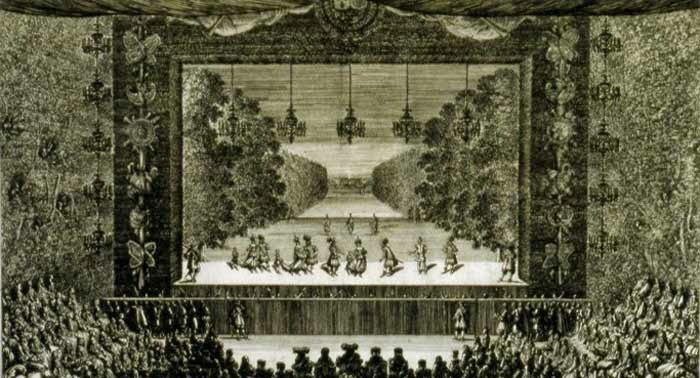
Molière's Theatre

From Les plaisirs de l’ile enchantée, the play performed on the stage is Molière’s La Princesse d’Elide. It was the first time it was ever performed in public.
Molière’s theatre celebrated the drama of artificiality. Like the literature, art and social customs of the time, the 17th-century French theatre was based on a formal set of rules and customs. While there were touring troupes who would travel through the country, often performing in makeshift spaces and on the streets, attending the theatre in Paris or at the court was a formal social event.

Performances in Paris were held either in public theatres or by special invitation only at the palace court. The theatres had a proscenium arch or a border framing the stage. Behind the arch, the scenery was composed of lavish painted sets, and the actors’ costumes were ornate. The lights remained on over both the audience and the stage, allowing the members of the audience to see and be seen at the event. When performing at court, the king would sit in an enormous throne in the center of the room with the rest of the audience positioned around him.

Like any event at court, strict rules of social behavior were expected to be followed. The creation of theatre also was subject to rigorous guidelines. The Académie Française, created by Cardinal Richelieu in 1635, was a group of intellectuals charged with regulating French language and culture. Their taste in theatre was firmly Neo-classicist: “Neo” meaning new, and “classicist” referring to the classics, the great works of Greek and Roman drama. The Académie created guidelines for “good” theatre, based on the writing of the ancient Greek philosopher Aristotle.

Aristotle depicted by Raphael, holding his Ethics: detail from the Vatican fresco The School of Athens, 1510 – 1511
Aristotle wrote that a tragedy contains three unities: time, place and action. Unity of time dictated that the action of the play take place in a single day and unity of place that the play take place at a single location. Unity of action determined that the action of the play contribute to the main story, without any distracting subplots. French tragedies were criticized by academics based on how well they adhered to these unities. While these rules might seem limiting, there were several playwrights, including Pierre Corneille (1606-84) the father of French tragedy, who flourished within them. In Corneille’s heroic epic, Le Cid (1637), as well as many of his other plays, the main character makes a moral choice to do what is right, regardless of personal cost. Jean Racine (1639-99) was another highly respected writer of tragedy. His plays, including Phèdre (1677), are very passionate and poetic and often focus on doomed love.

The language of tragedy also was expected to conform to strict rules. French plays were written in Alexandrine couplets—a verse form that consists of two rhyming lines of 12 syllables each. Each rhyming couplet was to contain a complete thought. As the verse form developed, so did rules about when pauses could occur (between the sixth and seventh syllable of each line.)

Molière began his career in the theatre as an actor, but found French tragedy too difficult. Delivering the Alexandrine lines was very demanding on an actor’s voice. As a performer, Molière found he did not have enough breath to perform the Alexandrine verse of tragedy, but instead he excelled as both an actor and writer of comedy. An evening at the theatre often would include a comedy as a companion piece to the more serious tragedy that was considered the main event. Louis XIV and the courtiers often would prefer the lighter fare of the comedies, especially Molière’s. While French tragedies were considered great literature by the academics, comedies were not taken as seriously and therefore not as subject to criticism of form and language. Molière had the freedom to write in both verse and prose, and he was considered the greatest comic writer of his time. (SCR’s production uses David Ball’s adaptation of Tartuffe, which abandons Molière’s use of rhyming couplets in all but a few scenes.)

Molière
Molière’s comedies were influenced heavily by Italian commedia dell’arte troupes touring Europe. Commedia dell’arte was based in improvisation and included stock characters in a variety of predetermined scenarios. The actors wore masks to define their character type and performed slapstick gags, called lazzi. Molière’s early comedies were based on commedia scenarios with scripted dialogue, instead of being improvised. They included stock characters and stunts, many of which Molière performed himself. Molière wrote comedies for his company, knowing who would play each part, and generally he would play the lead role.

,Molière also incorporated masks into his work, but instead of simply using them to define character types, Molière used the masks as a metaphor for the masks people wear to hide their true selves. Molière’s comedies were sharp social commentaries, satirizing the behavior and hypocrisies of the nobility. Though Molière’s company had the support of the court, and was frequently asked to perform there, his plays often were censored or banned because they would insult the nobility and the religious clergy.

In a society of artifice, Molière used the theatre to mock the affectations of his audience of socialites. While occasionally getting him into trouble, his satires earned him the reputation of one of the greatest comedians of all time.

Learn more and buy tickets

Tuesday, May 13, 2014

Extravagance Made by Hand

Fabric, patterns and Sonya Berlovitz' designs for Valere's suit in Tartuffe.
Whisk collar.
Bodices, petticoats, and waistcoats are just a few of the pieces involved in period clothing. With South Coast Repertory’s production of Tartuffe inspired by the 17th century, certain design needs and techniques are required. In an era of fashion with copious amounts of layers and fabric, a copious amount of work is needed to achieve the structured extravagance of that century.

Actor Christopher Carley in his floral suit costume.
From hand-making over 240 covered buttons to embroidering gloves to hand-crafting a whisk collar, Tartuffe called upon every able body to accomplish the design. Costume designer Sonya Berlovitz chose to remain inspired by the 17th century but played with lines and fabrics to emphasize the comedy and themes within the play. Her design is an update of her past work with director Dominique Serrand and his previous productions of Tartuffe. To help with time constraints, she refined parts of her design to ease the work load. Yet, even pieces that are typically simple, called for more care.

Seemingly straightforward, the suit for the young lover, Valere, used traditional tailoring to assemble the look. Going through the typical stages of patterns, sewing, linings and finishing touches, the suit needed a little more detail work. The trickiness with the suit lay within the floral fabric. To help accent the floral print, the Costume Shop appliquéd flower clusters from another fabric onto the suit, creating the illusion of larger flowers.

The underskirt.
On the other end of the spectrum, the biggest challenge of Tartuffe was Elmire’s blue dress. Clocking in at around 80 hours of work with 60 of those hours spent on the skirt alone, this dress demanded attention. The shop began with muslin mock-ups used in rehearsal to make sure the design was functional. Following its testing stages, blue silk taffeta—measuring at 10 yards around the skirt—was then bonded onto a knit fabric to create a sturdy layer. Then, two days were dedicated to hand-stitching cartridge pleating around the length five times to achieve the desired look.

The almost completed skirt.
The skirt was then sewn as a “bubble,” meaning the bottom hem was tucked back and sewn under the skirt. To finish it off, 30 yards of blue netting is worn underneath it with the a hoop petticoat to give it a structured shape. Hidden from the audience, a zipper was included underneath to allow the wardrobe crew the ability to lay it out and press it for each performance.

Tartuffe gave the Costume Shop a chance to flex its muscles and tackle the demands of 17th century inspired clothing. The costume shop used many of its tricks and techniques to get each design element as envisioned by Sonya. All the hours spent on every piece of costuming results in an extravagant design that further supports the monolithic styling of SCR’s Tartuffe.

 Learn more and buy tickets.

Monday, May 5, 2014

The Dark Underbelly of Molière’s "Tartuffe"

SCR's 1964 production of Tartuffe.
In 1664—350 years ago—Molière’s Tartuffe opened in France and was immediately censored, causing a five year firestorm and several rewrites until its eventual run (for more about the controversy surrounding the original production, peek into our program). In 1964, SCR Founding Artistic Director Martin Benson directed a production of Tartuffe under the auspices of the newly created theatre company that he founded with David Emmes. An hour or so long, the piece was based in commedia dell’arte and used masks. Instead of stirring up trouble, Tartuffe was the first in a long line of successes for a small company that grew into the South Coast Repertory of today.

Fifty years later, SCR concludes the celebration of its landmark season by revisiting Tartuffe. In true SCR style, we aren’t content to rest on our laurels and present the easy version of an historical classic, but are approaching it with fresh eyes and interpretation.

The story remains the same. This dark comedy follows Tartuffe, a clever man who knows how to work every angle. A family watches in astonishment as Orgon, the head of the household, falls under Tartuffe’s spell of ideal piety. With beautiful women like Elmire and Mariane in the family, it’s difficult for Tartuffe to keep his thoughts turned toward heaven. Tartuffe's always got his eye on a prize and knows how to play the gamebut will he win in the end?

Director Dominique Serrand has been working to perfect his vision of Tartuffe since 1998, in collaboration with adapter David Ball. Serrand’s approach to Tartuffe emphasizes the fanaticism and zealotry inherent in Tartuffe’s manipulation of Orgon and employs judicious use of religious iconography.

Serrand’s darker and layered approach to the play, rather than treating it as a simple French farce, is at the forefront of a more nuanced view of Tartuffe. Julia Prest, in her book Controversy in French Drama: Molière’s Tartuffe and the Struggle for Influence, notes that “Modern directors have, even as they have allowed themselves to stray from Molière’s original text and content, in fact perceived something that has been paid less attention by scholars but that I shall argue was present in the Tartuffe controversy all along: a simultaneous condemnation of fanaticism (or in seventeenth century parlance, zealotry) as well as hypocrisy.”

Tartuffe set rendering , designed by Dominique Serrand and adapted for SCR's stage with Tom Buderwitz.
SCR’s production of Tartuffe has an interesting history and presented some unique challenges. Serrand has mounted this adaptation twice before, in 1998 and 2006, in theatre spaces that are very different from South Coast Repertory’s Segerstrom Stage. Serrand designed the sets for those productions, and for this outing he partnered with longtime SCR set designer Tom Buderwitz to to realize his vision. They are re-imagining the feeling of the original production—a monolithic set that evokes the atmosphere of a house of worship—with imposing walls surrounding the stage that dwarf the actors. This newly remounted production is a co-production with Berkeley Repertory Theatre and Shakespeare Theatre Company and, after its run at SCR, will travel to those theatres, which also have different stage footprints. Buderwitz and Serrand worked to create a set that is adaptable and scalable, so the walls will come apart to allow for expansion and contraction in Berkeley and Washington, D.C.

Costume rendering for Elmire by Sonya Berlovitz.
Costume designer Sonya Berlovitz worked on the previous productions of Tartuffe with Serrand and is has returned to reinvent the elegant and occasionally anachronistic 17th-century costumes. Her designs incorporate the feeling of the period, while exaggerating the lines and excess, appropriate for a comedy that is also tragic in its content. The sound design by Cory Carillo is based on Serrand’s original sound design, with rich and complex music, often using opera to underscore and heighten the dramatic action of the play. The design team is completed with lighting design by Marcus Dilliard.

Ultimately, Serrand’s approach and the supporting production elements serve to highlight the darker underbelly of Molière’s text. The religious imagery is juxtaposed with bold depictions of Tartuffe's worldly appetites, and Serrand gives full value to the tragic implications of Organ's single-minded devotion to the hypocrite, Tartuffe.  Of course, like life, there are still many moments of laughter, even when it is a laugh born out of desperation.

Learn more and buy tickets.

Friday, April 25, 2014

Do You Tartuffe? Meet the Cast That Does

THE CAST:  Gregory Linington, Nick Slimmer, James MacEwan, Callie Prendiville, Cate Scott Campbell, Lenne Klingamen,
Steven Epp, Becca Lustgarten, Luverne Seifert, Suzanne Warmanen, Chrisopher Carley, Nathan Keepers,
Brian Hostenske and Michael Manuel.
The rehearsal room at South Coast Repertory is packed: fourteen actors comprise the cast for Tartuffe. SCR’s final production of the 50th season is a new adventure for some; for others, it’s a return to a play they love (and four of them have been in previous productions of Tartuffe at other theatres). Some are new to SCR; four are graduates of SCR’s Theatre Conservatory—the Acting Intensive Program—and have supporting roles in Molière’s classic. One actor even has studied clowning. Find out more about our cast for Tartuffe.

Cate Scott Campbell (Elmire) previously appeared at SCR in Pride and Prejudice. Her other theatre credits include A Midsummer Night’s Dream at La Jolla Playhouse and several productions with Chalk Repertory Theatre, including the world premiere of Mommune. In New York, Campbell appeared in The Contrast (Mirror Repertory Company) and produced and starred in an evening of short plays at The Barrow Group. Her television credits include “One Life to Live” and the final season of “How I Met Your Mother.”

Christopher Carley (Valere) is working at SCR for the first time. His New York theatre credits include, on Broadway, The Beauty Queen of Leenane (directed by Gary Hynes); off-Broadway in A Skull in Connemara (Roundabout Theatre Company) and Once in a Lifetime (Atlantic Theater Company); and off-off Broadway in On the Nature of Religion (Atlantic Theater Company) and Suspicious Package (Wordmonger Productions). Regionally, he has appeared in The Cripple of Inishman (Portland Center Stage) and Poor Beast in the Rain (directed by Wilson Milam). In film and television, his credits include Gran Torino (directed by Clint Eastwood), Lions for Lambs (directed by Robert Redford), Garden State (directed by Zach Braff), Agent Orange (directed by Tony Scott), American East, Miss Nobody, Homecoming, “The Sopranos,” “House,” “CSI: NY,” “The Crazy Ones,” “Law & Order: SVU,” “ Studio 60 on the Sunset Strip,” “Num3ers,” “Veronica Mars,” “Ro,” “Ed” and “Campus Ladies.”

Steven Epp (Tartuffe) is making his SCR debut. Epp is an actor, writer, director and was co-artistic director at Theatre de la Jeune Lune, winner of the 2005 Tony award for Best Regional Theatre, from 1983-2008. His acting credits include title roles in Tartuffe, Crusoe, Hamlet, Gulliver, Figaro, The Miser, The Servant of Two Masters and Accidental Death of an Anarchist. He co-authored Children of Paradise, winner of the 1993 Outer-Critics Circle award for best new play. His regional credits include productions at Guthrie Theater, La Jolla Playhouse, Berkeley Repertory Theatre, Trinity Repertory Theatre, The Spoleto Festival, American Repertory Theatre, Actors Theatre of Louisville, Alley Theatre, Intiman Theatre, CenterStage, The Shakespeare Theatre, PlayMakers Repertory, Seattle Repertory Theater, and The New Victory Theatre, off-Broadway. Epp is the co-artistic director of The Moving Company based in Minneapolis. He was a 1999 Fox Fellow, and a 2009 McKnight Playwrights Center Theatre Artist Fellow.

Brian Hostenske (Damis) appeared at SCR previously in Pride and Prejudice, Noises Off, The Brand New Kid and Junie B. Jones and a Little Monkey Business. His theatre credits include Bloody Bloody Andrew Jackson at Center Theatre Group; Edith Can Shoot Things And Hit Them with Artists at Play (Los Angeles Ovation and GLAAD Media Award nominations), Playboy of the Western World at A Noise Within; The Winter’s Tale and Twelfth Night at Shakespeare Santa Cruz; and Mother Courage at La Jolla Playhouse. 


Nathan Keepers (Laurent) is making his SCR debut. He co-runs The Moving Company in Minneapolis, where he has co-conceived, written, directed and performed (respectively) in For Sale, Out of the Pan Into the Fire, Werther and Lotte, All’s Fair and Come Hell and High Water. Keepers was with Theatre de la Jeune Lune for 11 seasons, where he co-created and performed in many productions including Chez Pierre, The Little Prince, Amerika, Fishtank, The Deception, The Miser, Tartuffe, The Little Prince and many others. In Minneapolis, he has been seen on stage at The Jungle Theater (Waiting for Godot, Fully Committed, The Swan), Ten Thousand Things, Guthrie Theater and Children’s Theatre Company. Nationally, Keepers has worked at PlayMakers Repertory, American Repertory Theatre, Berkeley Repertory Theatre, Actors Theatre of Louisville, Alley Theatre, La Jolla Playhouse and The Folger Theatre in Washington, D.C. He studied with Pierre Byland in Switzerland and Philippe Gaulier in London. 


Lenne Klingaman (Mariane) is making her SCR debut. Her recent credits include Juliet in Romeo & Juliet (Denver Center Theatre Company); Rita in Elvis’ Toenail (Sidewalk Studio Theatre), Viola in Twelfth Night, The Three Musketeers, Henry IV, Part 1, A Midsummer Night’s Dream (Shakespeare Santa Cruz); Richard III (Intiman Theatre); Flight (P3/east); The Rehearsal, Richard III, Noises Off (A Noise Within); and Measure for Measure, The Fantasticks (Colorado Shakespeare Festival). Her television and film credits include “Cold Case,” Dear White People, Twenties, Love: As You Like It and The Exchange. She recently starred in “The Lizzie Bennett Diaries” spin-off “Welcome to Sanditon.”

Gregory Linington (Cleante) is making his SCR debut. He recently understudied all three roles in the world premiere of Discord: The Gospel According to Jefferson, Dickens & Tolstoy (and performed two of them). A 12-year company member of the Oregon Shakespeare Festival (2000-11), his favorite roles there include Berowne, Cassius, Gratiano, Edgar, Proteus, King Henry VI, Diomedes, Demetrius, Sebastian and Ferdinand; Trofimov in The Cherry Orchard; Mr. Marks in Intimate Apparel; Damis in Tartuffe; and Jack Rover in Wild Oats. He has been part of world premieres at Oregon Shakespeare Festival including Equivocation, Welcome Home, Jenny Sutter and Throne of Blood with tours to the Kennedy Center, Seattle Repertory, Arena Stage and Brooklyn Academy of Music. His television appearances include “Grey’s Anatomy,” “Shameless,” “Major Crimes” and “The West Wing.” He worked extensively with Misery Loves Company in Prague, CZ (1995-99) and trained at the Pacific Conservatory for the Performing Arts (Class of 1993). In 2013, he completed the Summer Intensive with SITI Company and Anne Bogart. He volunteers at Los Angeles High School, teaching Shakespeare.

Michael Manuel (Madame Pernelle/Officer) is happy to be returning to SCR where he appeared as Big Stone in Eurydice, Francis Flute/Thisbe in A Midsummer Night’s Dream and in numerous readings and workshops since 1994. Manuel was last seen in Impro Theatre’s Unscripted Shakespeare at the Pasadena Playhouse. He has worked in regional theatres across the country including The Empty Space Theatre, Seattle Repertory, Group Theaters, Yale Repertory, New Jersey Shakespeare Festival and Theatre For a New Audience on the East Coast. In Los Angeles, he has worked with the Mark Taper Forum, Cornerstone Theater Company, A Noise Within, Shakespeare Festival LA, Geffen Playhouse, Interact Theatre Company, Upright Citizens Brigade, Main Street Players, About Productions and Parson’s Nose. He has appeared in numerous television programs and films. 


Luverne Seifert (Orgon) is making his SCR debut. His performance credits include The 39 Steps, Servant of Two Masters, The Government Inspector, The Ugly One (Guthrie Theater); The Music Man, Measure for Measure, Vasa Lisa, Man of La Mancha, My Fair Lady, Othello, Raskol, Richard the Third, Little Shop of Horrors, Antigone (Ten Thousand Things); and For Sale (The Moving Company). His other theater credits include Polonius in Hamlet, (off-Broadway, New Victory Theater); Tartuffe, Amerika, The Three Musketeers, Chez Pierre, Children of Paradise, Gulliver, Twelfth Night, The Hunchback of Notre Dame, Yang Zen Froggs, Germinal, Don Juan Giovanni (Theatre de la Jeune Lune where he was an artistic associate); The 39 Steps (Arizona Repertory Theater); The Lion, the Witch and the Wardrobe, Tales of a West Texas Marsupial Girl, Antigone (Children’s Theater Company) and productions at La Jolla Playhouse, Berkeley Repertory Theatre, Trinity Repertory, ArtsEmerson and Spoleto Festival. He is currently head of the bachelor of arts actor training program at the University of Minnesota. He received a 2003 McKnight Fellowship for Theater Artists and a 2009 Ivey Award. Training Augsburg College, Burlesque Center for Clown, Switzerland. 


Suzanne Warmanen (Dorine) is making her SCR debut. Her theatre credits include Pride and Prejudice, The Winter’s Tale, Macbeth, The Importance of Being Earnest, A View From the Bridge, Lost in Yonkers, Pirates of Penzance, Hedda Gabler, The Playboy of the Western World, Summer and Smoke, A Midsummer Night’s Dream, Much Ado About Nothing, The Rover, A Doll’s House, Top Girls, Tone Clusters, Naomi in the Livingroom and A Christmas Carol—all at Guthrie Theater; A Lovely Sunday for Creve Coeur at Gremlin Theatre; All’s Fair/The War Within at The Moving Company; Amerika, or the Man Who Disappeared at Theatre de la Jeune Lune and Measure for Measure at Ten Thousand Things Theatre. Her recordings include the vocal CD “All Around Woman.” She appeared in the film Herman, U.S.A. She is the recipient of the 2009 Society of Promethians award.


Becca Lustgarten (Servant) is thrilled to be returning to the SCR stage this season, where she recently portrayed Letta in Death of a Salesman, directed by Marc Masterson. Her favorite credits include Three Sisters at the Williamstown Theatre Festival, directed by Michael Greif, Joseph and the Amazing Technicolor Dreamcoat at the Hangar Theatre, directed by Kevin Moriarty, and a number of new plays developed and produced by the Actors Studio NYC and Primary Stages ESPA* Drills. Lustgarten received her BFA in theatre arts from Boston University and studied at the Accademia dell’Arte in Arezzo, Italy. She is a graduate of the South Coast Repertory Acting Intensive Program. In addition to her theatrical work, she is a musician and singing bartender.

James MacEwan (Soldier/Officer) was born and raised in Johannesburg, South Africa. He is a graduate of South Coast Repertory’s Acting Intensive Program and is thrilled to return to SCR after appearing in A Christmas Carol in 2013. Some highlights from his South African credits include Mamma Mia, The Rocky Horror Show, Grease, Don’t Drink the Water and The Beauty Queen of Leenane. He has appeared on international television in “Wild at Heart” and the HBO series “Generation Kill.”

Callie Prendiville (Servant) is a graduate of the SCR Acting Intensive Program, and has also studied at the American Conservatory Theater in San Francisco, the Will Geer Theatricum Botanicum and Queen Mary College in London. Recent credits include Mary in The Car Plays at La Jolla Playhouse; Cecily in The Odd Couple at North Coast Repertory; Abigail in The Crucible at MOXIE Theatre; Emma in The Language Archive; and Mayella in To Kill a Mockingbird. She is also an actor with the Story Pirates, a sketch comedy troupe that encourages literacy by performing stories written by children. Prendiville holds a BA in Theatre Arts from the University of San Diego and an MFA in Performance in Theatre, Television, and Film from CSU Los Angeles.

Nick Slimmer (Servant/Officer) is thrilled to be returning to SCR’s Segerstrom Stage for his second show of the season, previously appearing as Thomas Shelley in A Christmas Carol. Slimmer is a graduate of South Coast Repertory’s Acting Intensive Program as well as a graduate of SCR’s Teen Acting Program. He plans on attending the American Academy of Dramatic Arts in the fall on a merit scholarship. Some of his favorite past roles include Peter in Peter Pan (Arts and Learning Conservatory), Matt in Dog Sees God (Garage Theater), Rapunzel’s Prince in Into the Woods (SCR Youth Conservatory), Henry Crawford in Mansfield Park (SCR YC) and Cat in the Hat in Suessical (SCR YC).

Learn more and buy tickets.