Showing posts with label Studio Series. Show all posts

Thursday, June 4, 2015

Meet Inmigrantes Teatro Artistic Director Raymundo Garduño

Miguel Ángel Rodriguez, Andrés Franco and Ariadnalí de La Peña in Kikiricaja. Photo by Alejandro Montalvo.
A year ago—at a theatre conference in San Diego—something incredible happened: attendees had the chance to cross the border into Tijuana, where they witnessed Inmigrantes Teatro’s work. SCR Artistic Director Marc Masterson and Dialogue/Diálogos Community Project Director Sara Guerrero were there and came away captivated by the company’s remarkable physical comedy, which transcended language and culture; next came the decision to invite them to SCR. Now one year later, Inmigrante Teatro's Kikiricaja: Una Historia de Payasos comes Studio SCR.

Kikiricaja Director Raymundo Garduño founded Inmigrantes Teatro in 2005 and serves as artistic director. The company made its debut with the play Naufragios (Shipwreck). Its other productions include the improv show, Los Improductivos (The Improductives), and Inmolación (Immolation). Inmolación was selected by Centro Cultural Tijuana as part of its Education Series Program and represented Baja California in the 2012 International Borders Theatre Festival and at the 2013 FESARES Baja California State Theatre Festival. Earlier this year, Inmigrantes Teatro presented Kikiricaja at La Jolla Playhouse.

We talked with Garduño to find out more about Inmigrantes Teatro and the show that comes to SCR's Nicholas Studio June 18-21:

Raymundo Garduño 
Why is your company called Inmigrantes Teatro?
Because, curiously, most of our founding members are immigrants. That is, none of us were born in Tijuana. The name also inspires a feeling of a traveler. We always wanted to tour our work as well. Hence, the name.

Why do shows for young audiences?
We always thought that a child’s first experience should be the best one. We aspire to create audiences by giving to children and youth good theatrical experiences that will always make them come back.

Was Inmigrantes Teatro the first to perform Kikiricaja
Kikiricaja is the result of a collaboration with Teatro Paraíso, one of the most important theatre companies for young audiences in Spain (and Europe). They already had produced the play in the ‘80s. I invited them to perform at a theatre festival for children that I produce every year. I became good friends with the company and, when we were looking for a script to produce, Teatro Paraíso’s director suggested Kikiricaja. Now we are the only company in the world with exclusive rights to produce it.

What lessons can be learned from Kikiricaja?
I always thought that Kikiricaja was a play about friendship, about the courage of having a friend. I don’t think that the  function of children's theatre isn't to teach or lecture, much less theatre for young audiences. To me, theatre should be a moving experience, a way to tell a story. What each person gains from that experience, or the way they reflect on it, may be the result of how well we tell a moving story. But I do think that Kikiricaja is a moving tale of friendship.

What makes you most proud about your theatre company? 
I think that our success in disseminating our work has made me proud—first in performing our work outside of our state and, then outside of our country. We also have a commitment to the audiences for whom our work is targeted: young people. It is not an easy job to work for children and youth, and I think we do it with lots of ethic and, most importantly respect, for them.

About Kikiricaja: Una Historia de Payasos

Loosely translated as “Cock-a-doodle-doo Box: A History of Clowns,” Kikiricaja: Una Historia de Payasos is a three-person play, performed entirely in Spanish, that tells the story of friends Bartolomeus and Comino, who live in beautiful wooden boxes where they dream, eat, play and invent worlds. Full of moments of happiness and sadness, fights and reconciliations, travel and adventure, this delightful piece shows how friendships can help us face the fears that make us feel small, as well as celebrate the hopes that make us feel like giants. A family-friendly show, Kikiricaja is recommended for ages 7 and above. This piece is performed entirely in Spanish. Fluency in Spanish is not required. Presented in association with La Jolla Playhouse.

Watch our video to learn more about the show.

Learn more and buy tickets.

Conozca a Raymundo Garduño, el Director Artístico de Inmigrantes Teatro

Miguel Ángel Rodriguez, Andrés Franco y Ariadnalí de La Peña en Kikiricaja. Fotografía: Alejandro Montalvo.
Hace un año—en un congreso de teatro en San Diego—algo increíble ocurrió: los asistentes tuvieron la oportunidad de cruzar la frontera a Tijuana, donde presenciaron el trabajo de Inmigrantes Teatro. El director artístico de SCR, Marc Masterson, y la directora del proyecto comunitario Dialogue/Diálogos, Sara Guerrero, estuvieron ahí cautivados por la extraordinaria comedia física de la compañía, la cual trasciende lenguaje y cultura. Fue ahí donde decidieron invitarlos a SCR. Ahora, un año después, llega Inmigrantes Teatro con su producción de Kikiricaja: Una Historia de Payasos a formar parte de la temporada de Studio SCR.

Fundada en 2005 por Raymundo Garduño, la compañía inició con la obra Naufragios. Otras producciones de su repertorio incluyen el show de improvisación, Los Improductivos, e Inmolación. Inmolación fue seleccionada por Centro Cultural Tijuana como parte de su Programa de Teatro Escolar y representó a Baja California en el Festival Internacional de Teatro en las Fronteras 2012 y en el Festival estatal de teatro de Baja California 2013.

Hablamos con Garduño para aprender un poco más sobre Inmigrantes Teatro y su producción Kikiricaja: Una Historia de Payasos, que vendrá a SCR el 18-21 de junio.


Raymundo Garduño
¿Por qué se llama Inmigrantes Teatro la compañía? 
Porque cuando inició la Compañía—los que la iniciamos—curiosamente la mayoría éramos inmigrantes, es decir ninguno era nacido en Tijuana. También es un poco el sentido del viajero, siempre quisimos ser un grupo que viajara con su trabajo. Por eso decidimos llamarnos así.

¿Por qué realizan teatro para niños y jóvenes?
Siempre hemos pensado en que la primera experiencia de un niño en el teatro debe ser la mejor. Creo que la mejor manera de crear público es darles una buena experiencia teatral a los niños y jóvenes para que quieran volver siempre a las salas.

¿Fueron ustedes los primeros en presentar la obra Kikiricaja?
Kikiricaja es el resultado de la colaboración con la compañía española Teatro Paraíso, uno de los grupos de teatro para niños más importantes de España (y Europa). Ellos habían montado esa obra allá por los ‘80s. Yo los invité a venir a un festival de teatro para niños que hago cada año y nos hicimos muy amigos. Y buscando un texto para montar, el director de aquella compañía me propuso hacer Kikiricaja. Ahora somos la única compañía en el mundo que la puede montar. Tenemos los derechos en exclusividad.

¿Hay alguna lección que debemos aprender al ver Kikiricaja?
Siempre he pensado que Kikiricaja es una obra sobre la amistad, sobre el valor de tener un amigo. Creo que la función del teatro no es enseñar o aleccionar, sobre todo el teatro para niños. Para mí el teatro debe ser una experiencia conmovedora, una manera de contar una historia. Lo que cada quien se lleve de esa experiencia o la manera en que lo reflexione es lo que pueda resultar de nuestra capacidad de contar una historia que conmueva. Pero si creo que Kikiricaja conmueve desde el lado de la amistad.

¿Cuál es tu más grande orgullo del trabajo de Inmigrantes Teatro?
Creo que el lograr la difusión de nuestro trabajo—primero fuera de nuestro estado y después fuera de nuestro país—además del compromiso que tenemos con el público al que dirigimos nuestro trabajo. No es una labor sencilla trabajar para niños y jóvenes, y creo que lo hacemos con mucha ética y sobre todo respeto hacia ellos.

Kikiricaja: Una Historia de Payasos

Una obra de Teatro conformada por tres personas en donde se cuenta ingeniosamente la historia de Bartolomeus y Comino, quienes viven en unas cajas preciosas donde sueñan, comen, juegan y hasta inventan mundos. Una historia de amistad que está llena de grandes y pequeños momentos de alegría y tristeza, peleas y reconciliaciones, viajes y aventura. Este espectáculo nos mostrará como las relaciones de amistad pueden ayudarnos a enfrentar aquellos miedos que nos hacen sentir pequeños; así como también, celebrar las ilusiones que nos hacen sentir como gigantes. Esta función es apta para toda la familia, se recomienda para niños de 7 años en adelante. Kikiraja se presentará completamente en español.

Watch our video to learn more about the show.

Learn more and buy tickets.

Monday, May 11, 2015

Who Is America's Greatest Rock Critic?


How to Write a Rock Play

How to be a Rock Critic is a collaboration between husband-and-wife team, Jessica Blank and Erik Jensen; they wrote it, she directs it and he acts in it. Inspired by Lester Bangs’ words, the couple spent two years creating this one-man play. They went through 50,000 pages of Bangs’ writings—both published and unpublished—and whittled it down to an 80-minute play that sheds light on his pioneering voice in music.

Erik Jensen and Jessica Blank
Jensen, an actor with notable roles in “The Walking Dead” and “CSI,” portrays Bangs. The couple's most notable work is The Exonerated, a play they co-wrote based on interviews with exonerated death row inmates. The Exonerated won the 2003 Drama Desk, Lucille Lortel and Outer Critics Circle awards and ran for more than 600 performances off-Broadway, toured nationally and was made into a TV-movie. How to be a Rock Critic is a Center Theatre Group commission, where it had a previous developmental workshop production.

Considered "America's Greatest Rock Critic," Lester Bangs was a pioneer—he put the “punk” in punk rock—and broke ground as the most influential voice in rock music. Bangs' story comes to life through the work of husband-and-wife team Jessica Blank and Erik Jensen, shedding light on Bangs’ messy life and his revolutionary voice in music in How to be a Rock Critic.

Lester Bangs
Lester Bangs was a gonzo journalist who notably wrote music reviews for Rolling Stone and CREEM magazines. His reviews were known for their radical, take-no-prisoners style, “The reviews I did for [Rolling Stone] really stuck out like sore thumbs.” Bangs said about his time with Rolling Stone. He was fired from Rolling Stone in 1973, “[They] threw me out for being, quote, ‘Disrespectful to musicians,’ end quote. I wrote a review of Canned Heat…making fun of them. I guess you're not supposed to do that."

Bangs immersed himself into the subject of his writing—he lived the rock ‘n’ roll lifestyle and was considered a peer to the artists he wrote about. In turn, his writing was honest and matched the excesses, energy and passion of rock ‘n’ roll music. He is considered a visionary of rock writing—Charles Bukowski and Jack Kerouac rolled into one. His criticism often was filled with cultural references of music, literature and philosophy and his writing was brash, yet intellectual.

“The appeal of Lester shares a lot with Kerouac: that innocence and goodwill and drive to describe and be true to what matters in life. Lester, like Kerouac, reads like a real good friend to a lot of people.” Said punk rock pioneer Richard Hall in a 2003 Village Voice article.

Bangs became the editor the rock ‘n’ roll magazine CREEM in 1971. Under his leadership, the magazine led the punk rock movement and was the first to write about the then up-and-coming music scene. Many claim the magazine—with Bangs’ at the helm—helped conceptualize and invent punk rock. In the 70’s, Bangs was also one of the first—years before the mainstream press—to give massive exposure to artists who would become 1980's icons like David Bowie, Blondie, Kiss and Motörhead. Bangs left Creem Magazine in 1977 and moved to Manhattan, where he became a contributor to the Village Voice. He considered his writings from this period to be some of his finest work and he started researching and writing his book, "Rock Gomorrah."  He died from an accidental drug overdose at the age of 33—he was listening to Human League’s album Dare.

Learn more and buy tickets.

Logo photo by Craig Schwartz.

Wednesday, April 8, 2015

How It All Comes Together


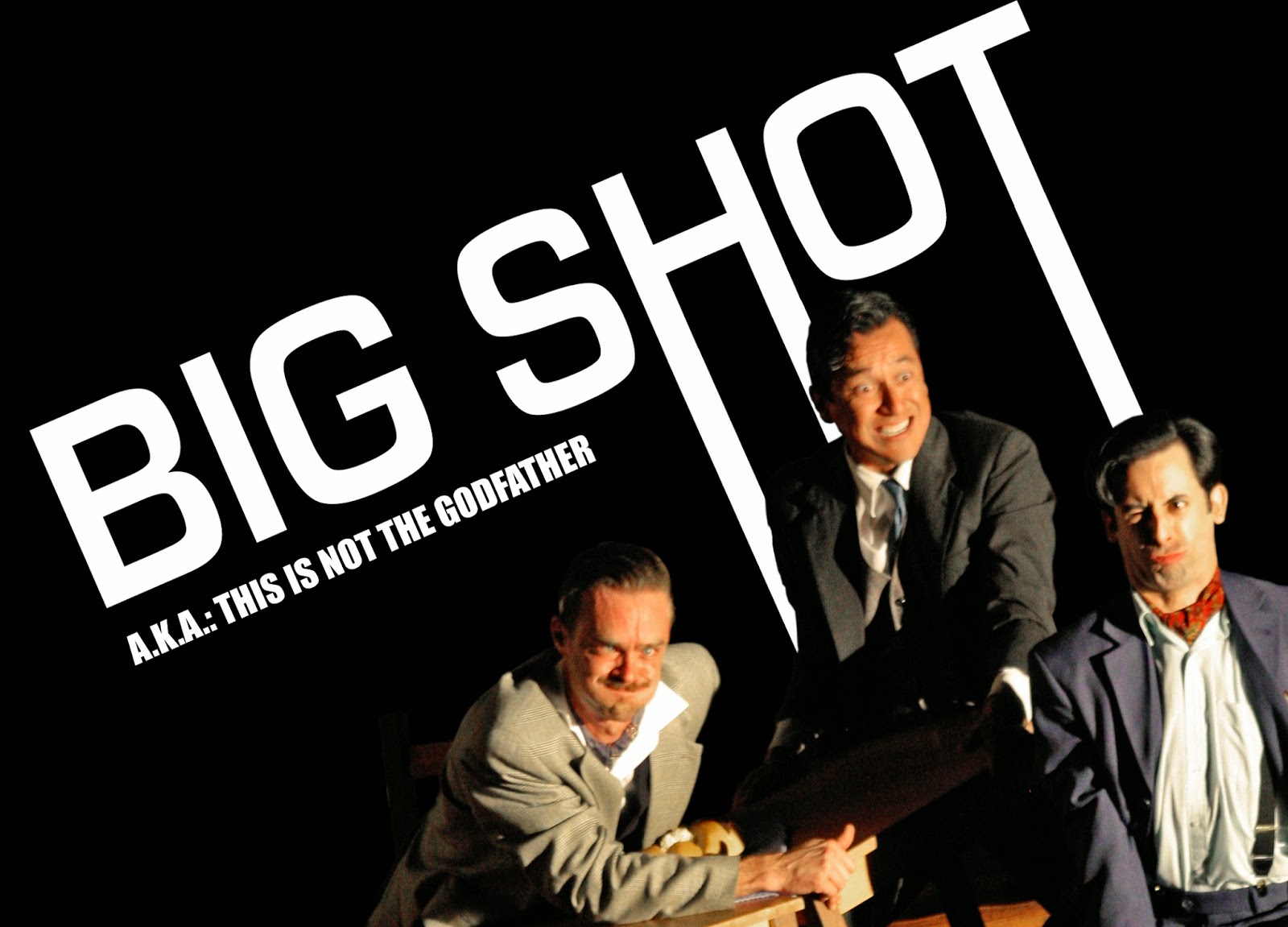
The third time’s a charm for Theatre Movement Bazaar (TMB) as they return to South Coast Repertory with BIG SHOT: a.k.a this is not The Godfather to kick off the 2015 Studio SCR season.

Theatre Movement Bazaar's Track 3
TMB previously presented Track 3 (2013) and Anton’s Uncle’s (2012) in Studio SCR and—like their Like their previous shows—BIG SHOT takes inspiration from another source—The Godfather films. So, how does TMB turn their inspiration into a full-fledged play? According to TMB co-founder Richard Alger, it all starts with text.

“We typically begin with a source material that interests us,” he says. “It may be a myth, a play or a novel. We then deconstruct this source, looking for threads and themes that interest us and then reconstruct this material into a text and songs, prepared and infused with many unwritten ideas.”

Sometimes text leads the action, Alger relates. Other times it is created to support or augment movement. The movement score is as important as the text.  This movement score is created during the rigorous physical exploration of rehearsal with the director and the actors.

This kind of approach to theatre is what TMB is known for—creating shows that are collage-like with a structure that is more musical than narrative. TMB founders Tina Kronis and Alger created BIG SHOT, which merges their collage-like structure with a more traditional story driven narrative.
“We bill it as a ‘vaudevillian collage,’” he explains. “We have freed our structure to be built rhythmically, referring obliquely to vaudeville acts, while at the same time allowing The Godfather’s narrative to inspire and echo throughout the piece. We are trying to create a space for something new to emerge, inspired by the original but injected with our sensibilities, interests, and themes that may only be touched on in the original.”

In BIG SHOT, the American gangster genre is flipped and told through a vaudevillian style with theatrics, dynamic movement, song and dance, exploring themes of family and crime.

“It is an homage to [The Godfather] and the people who came together to make it.”

BIG SHOT is a new work still in development that was originally workshopped in 2014. The play makes its world premiere at SCR—in Studio SCR and the 2015 Pacific Playwrights Festival. Alger, along with co-creator Kronis and the cast are currently in rehearsals and continue to develop the play.

“The production that is developing is very funny, provocative, energetic and surprising,” says Alger. “It utilizes the many talents of our performers and challenges them to find fresh and unexpected approaches to theatricality.”

About Theatre Movement Bazaar
Theatre Movement Bazaar is a company dedicated to creating original performance works with an emphasis on physical action. The company merges elements of dance, text, cinema, and media from diverse sources into a complex performance. It investigate these elements, modifying or neutralizing them, de-contextualizing them from their sources. Liberated from their contexts, TMB’s elements are free to be structured in new and surprising ways, creating a connotative network of echoed and reverberant meanings. In this multifarious approach, the company strives to reinvigorate theatre for a contemporary audience.

TMB began in New York City as collaboration between choreographer/director/performer Tina Kronis, and mechanical engineer/writer, Richard Alger. In 1999, the company relocated its base to Los Angeles, and has produced original works, garnering critical attention and presenting its work across the United States and in the U.K.
Learn more and buy tickets.

Wednesday, May 28, 2014

Down and Dirty with Brendan Hunt and "Absolutely Filthy"


Awards for Absolutely Filthy:
  • LA Weekly Theatre Award: Best Comedy Ensemble, Best Female Comedy Performance (Anna Douglas) and Best Male Performance (Brendan Hunt)
  • 2013 Hollywood Fringe Festival: Best of the Fringe, Best Comedy and Best Actor (Brendan Hunt)
  • 2014 New York International Fringe Festival: Official Selection
Absolutely Filthy cast, creative team and crewat the Hollywood Fringe Festival awards.
Absolutely Filthy is a Los Angeles theatre favorite and award-winning play presented by Sacred Fools Theatre Company. This unauthorized parody about a grownup Pigpen from the "Peanuts,"Absolutely Filthy is a dark, dirty comedy that follows a character named The Mess as he reconnects with his childhood pals at the funeral of his estranged best friend.

We sat down with playwright Brendan Hunt—who also portrays The Mess—to talk more about Absolutely Filthy:

What inspired the use of these well-known characters to tell the story?
One day I was mentally loitering on the topic of the things that parents say to their kids, and the unexpected effects those things can have, and it struck me that "Pigpen" is a pretty rough nickname to endure. I totally understand that nothing ill was meant by any parent who may have actually applied that name to a messy child, but nonetheless, calling a kid "Pigpen" could be seen as saying "you are so dirty you remind of the location pigs utilize for both eating and shitting."

At what point does a label like that become inescapable? If a toddler who gets dubbed "Pigpen" grows into a teenager—who still has serious hygiene problems—is he still named Pigpen because he's messy? Or is he still messy because he was named Pigpen?

What has been your creative process of this work—both as a playwright and performer?
It has been a very unique experience and one that is hard to quantify; along with director Jeremy Aldridge we sort of had to figure it out as we went along.

I studied theatre at Illinois State University, and one of the main things I learned always to serve the piece. Whatever choice you make—be it as an actor, director, designer—let it always be something drawn from the script that serves the piece as a whole, not just any amusing whim you may have. That's been a valuable rule of thumb and very good way to find the best option when many different options present themselves.

How has this work evolved—from your original concept to what we’ll see at SCR?
It started as one solitary 10-minute episode, with absolutely no guarantee that there would ever be a second.

Photo by Shaela Cook
Sacred Fools Theatre Company has a semi-regular late-night show called "Serial Killers," wherein 10-minute episodes of five different stories are presented, like a sketch night, but sketches with a long narrative. The audience then votes which three stories they want to see return the following week, while the other two "serials" are "killed."

The show that would become Absolutely Filthywas fortunate enough to be voted back 13 times, which meant that I got the chance complete the arc of a story. At that point, the theatre was pitting together its next MainStage season, and it was suggested that I submit what was at that time called Pigpen at 30for consideration.

What I gave them was literally just the first 10 episodes, cut-and-pasted together. It was by no means a finished article, especially rhythmically and, due to the serial structure, there was a cliffhanger exactly every 10 minutes.

The powers that be at Sacred Fools eventually decided to include it in the season, with the assumption that I would continue to flesh out the script. That worked out pretty well.

What do you want people to come away with having experienced it?
A desire to go home and take a bath.

Praise for Absolutely Filthy

  • "The play is labeled as a parody... this does the play an injustice... It's the most unique play I've seen this year."—Kevin Taft, Edge Los Angeles
  • "Intense and compelling... An ambitious play... grandly served by the consistently pitch-perfect ensemble and inspired, imaginative direction."—Myron Meisel, The Hollywood Reporter
  • "Absolutely stupendous... The ensemble performances are stellar."—James Scarborough, The Huffington Post
  • "Darkly hilarious... comedy gold."—Mayank Keshaviah, LA Weekly

Absolutely Filthy comes to South Coast Repertory as part of Studio SCR, June 5-8.Learn more and buy tickets

Monday, May 12, 2014

Q & A with Katharine Noon—Director of “The Bargain & the Butterfly”

In June, The Ghost Road Company brings The Bargain and the Butterfly to Studio SCR. Combining science and fantasy, this haunting new play explores the delicate intersection of genius and madness. The Ghost Road Company is a theatre ensemble dedicated to the creation of new work for the stage, through a collaborative process. In this interview, learn more about their unique approach and how it led to the development of The Bargain and the Butterfly from the show's director, Katherine Noon.

Katherine Noon
The Bargain and the Butterfly was inspired by Nathaniel Hawthorne's story, "The Artist of the Beautiful." What specifically led to the play's creation? How was it decided that this would be the next Ghost Road production?
Initially it started with artistic burn out! Ghost Road had just come off a large project and I had nothing left creatively. I wondered what it was about with regard to some people who seemed to have endless creative energy and were prolific in their output. I began to research psychology and neurology and kept coming up with the very narrow border that divides madness from genius. I know this is territory that has been well-trod, but I did find one interesting bit of information about a new discovery concerning a variant on a gene. People with this variant have an equal chance of being a genius or being schizophrenic. This led me to think about genetics and the imminent ability of parents to choose genetic traits for their unborn children. And I wondered, if it was possible, would anyone choose for their child to be a genius with the knowledge that they were risking schizophrenia?

About this time I came across Hawthorne's short story, "The Artist of the Beautiful;" a story about a young clock maker and his desire to make a perfect clockwork butterfly that would possess perpetual motion and, by all accounts, a soul. Achieving this would require "spiritualizing the machinery." The price he paid for "bettering" nature was that the mechanism required a part of his own life force in order for it to be imbued with life. I began to draw connections between the research into neurology and the short story with the ideas of invention, genius and giving life to the lifeless even if it means that destruction lies in wait. I would add that there are also connections to be made with "Frankenstein" by Mary Shelley in both Hawthorne's story and The Bargain and the Butterfly.

How did the Ghost Road Company adapt the story into a play in terms of the the story, the characters, and the scenic design?
Everything we do is collaboratively created. The leader of the process, in this case me, brings their ideas and research to the group. The most important things that I can bring to the process are the questions I am asking in the development process. The company uses various, techniques to create new work including improvisation, group writing and physically based methods for creating story and character. Because the creation of space is integral to making the work, the company is always creating and re-creating the world of the piece throughout the workshop process. Certain things begin to repeat and those are the elements that stick. When we did an initial showing of the unfinished piece, the basic scenic ideas existed in that presentation. The final set by Maureen Weiss was a more designed and polished version of the original vision. Our sound designer, Cricket Myers, added a new layer to the world by underscoring the piece with an abstract soundscape. This had the effect of bringing the audiences into the interior world of the characters. If we had our way we would always work with designers as part of the development process, but often that is not possible due to schedules, financial constraints, etc. There were thematic elements that interested us in the Hawthorne short story such as spiritualized machinery, literally giving part of yourself to a creation, and diminishing one's uniqueness in order to "fit in."

The main character in the short story is a young man named Owen. In our version, we made the central character a woman named Annie. Instead of a perpetual motion butterfly, Annie is trying to give her comatose twin brother, Owen, his soul. They are twins: two sides of the same person. As the performance unfolds, lines become blurred and one is unsure if what is being experienced is real or a figment of Annie's imagination. In the original story there is an absence of a mother for both the characters of Annie and Owen. The idea of an absent mother became integral because it felt as if she hung over the world like a specter. It is her past actions that sets this world in motion. Other strong elements throughout the creation process were the ideas of genetic manipulation, obsession and consuming knowledge—an idea we make quite literal in the piece.

How has the play evolved from where it started to where it's at right now?
I would say more than anything our audiences have shaped this piece. There is room in the work to take away from it your own ideas about what is happening on stage. It is this feedback as to what characters and ideas resonate for audiences that have had a great influence on the work. When I was first cobbling together the workshop material for a preliminary public presentation, the piece felt like disparate vignettes that were heading in the right direction. Feedback from the audience at that point solidified what we knew and helped us clarify our goals moving forward toward completing the work. The ending was the most difficult thing to come up with. We did not actually have an ending until a couple of weeks before we premiered the show in Los Angeles. The other major element, of course, is the creativity and input of the company. There are many tough rehearsals where things may not be working, but the company sticks with the process and, we all wade through the mire together in order to figure out a solution. It can be challenging to exist in a surreal world and still make sense of the journey each character takes. The hours spent working through the details with the ensemble contributed greatly to creating cohesion and a dynamic arc for each story line.

What were the most challenging obstacles to adapt the piece for the stage, as well as perform it?
Time and space are the two indispensable things required in order to engage in ensemble-devised work. Unfortunately, those are the two things hardest to come by. When an actor engages in this work, they are committing a large portion of their lives to a single project. It takes a special person who is willing to settle into this process. Space is integral to creation. Because we are a transient company, we often do not have the luxury of creating in the same space day in and day out. This piece was particularly difficult because we would get established in one place and then need to move with all our materials in tow. Economics plays a big part in this and renting a space for long periods of time can be prohibitive.

As far as the piece itself, I think one of the most challenging aspects was pushing the work into a more physical direction. Our work in the past has been dominated by language and we wanted to find a physical vocabulary to support the language. We spent time in Poland in a residency with Stadium Teatralne, a company in Warsaw, and that exposure really helped to move us in that direction. Shifting gears from the verbal to the physical forced me to see the process differently because it caused me to work in a less familiar way. Another challenge was finding ways for the scientific inspiration and the Hawthorne story to merge. This meant treating both things like a jumping off point. I don't consider this an adaptation but a new piece. And because it was not technically an adaptation, there was a lot more room to create but less of a structure to hang the ideas on.

What was the response like during the Los Angeles performances?
The response has been very positive. They come away intrigued and surprised by the world they encounter in the piece. The most gratifying thing of all is what the show sparks in each individual and how it touches them personally. It is exciting to see the play work on many levels: personal, universal, literal and metaphoric.

For the Los Angeles performances, we scheduled the shows in an unconventional way. Instead of spreading performances over 4 to 6 weeks, we did 12 performances in 14 days. I believe this added urgency and created the feeling of a special event. The vibe in the audience was that they were all in on a secret together.

What prompted the idea to tour the show in Poland?
We have been going to Poland for several years; we have a relationship with Joanna Klass and the Adam Mickiewicz Institute in Warsaw. Joanna has been instrumental in connecting us with Polish Theatre artists, such as Studium Teatralne. We have also, under the auspices of the Mickiewicz Institute and the Polish Ministry of Culture, done staged readings of Polish plays in Los Angeles. We performed one of those plays at the Korczac Festival in Warsaw at the same time we took The Bargain & the Butterfly to Poland. All our experiences with Polish theatre have been building to the time where we would be able to take our own work there.

Poland has a very deep theatrical tradition that is an integral part of its social, political and cultural dialogue. The Bargain & the Butterfly resonated differently for Polish audiences than it did for Los Angeles audiences. I would say it was felt more deeply on both a personal and cultural level, and because of our work with Studium Teatralne, the Polish audience recognized the influences from their theatrical aesthetic. The audience was almost entirely Polish but there was no loss of understanding or nuance even though there is a good deal of poetic language in the piece. I think what was most gratifying for Ghost Road was that the piece held its own with other Polish theatrical works.

What are GRC's future plans for the play?
We are currently in discussions to take the show to the Ko Festival in Amherst, Mass., and Irondale Theatre in Brooklyn. The trip to Irondale would also include an exchange of development methods and training with the Irondale Ensemble. In addition, we are applying to a number of national and international festivals with the play. We are also currently in development workshops for our newest piece based on the Oedipus story.

Anything else you would like to be quoted on, this is your moment.
Two things I always try to remind myself of as I embark on something new:
  • If it doesn't scare you at least a little, then it probably isn't worth doing.
  • Never wait to do something until you're ready. You will never be ready.
See The Ghost Road Company's The Bargain and the Butterfly in Studio SCR, June 12-15. Get your tickets today!


Wednesday, February 19, 2014

A New Show Every Night with Impro Theatre


What is Improvisational Theatre?

Improvisational theatre —also known as Improv—is a form of theatre, in which the plot, characters and dialogue of a game, scene or story are made up in the moment. Often, for inspiration, improv performers will take suggestions from the audience, or draw on another source of inspiration to get started.

Inspired by Tennessee Williams, Impro Theatre blends Williams’ masterful storytelling and language with their own brand of hilarious improvised theatre in Tennessee Williams UnScripted. Each show is different and never the same; no pre-planning or prepared scenarios, just a single audience suggestion as inspiration gets the show started. From that, the ensemble of actors instantly bring characters and a plot to life in a completely improvised full-length play.


Impro Theatre is an improvisational theatre company that creates completely improvised, full-length plays in the styles of the world’s greatest playwrights, authors and composers, including Shakespeare, Tennessee Williams, Jane Austen, Anton Chekhov, Stephen Sondheim, Charles Dickens, and more. The performers immerse themselves in these styles, and in the moment, they write theatre as they perform it, combining verbal dexterity and dynamic physicality to bring character and plot to life in an instant.

Watch a clip from a previous Tennessee Williams UnScripted.


Studying the styles of literary greats, like Williams, Impro Theatre’s ensemble of performers expands on what these writers do, with the goal to capture their essence and honor their voice. Rather than parodying the writers, the ensemble plays for truth in the storytelling and allows the comedy to come from it. More over, Tennessee Williams UnScripted is not just a performance that is being improvised, but also the technical elements like the lighting design and music. The lighting designer and musicians watch the performances and improvise their work to match the mood of the story that is being created in front of them.

There are four chances to see Tennessee Williams UnScripted and four entirely different shows to experience. Impro Theatre brings their unique brand of theatre to South Coast Repertory as part of Studio SCR, Feb. 27-Mar. 2.

Get your tickets today!


Praise for Tennessee Williams UnScripted

Impro Theatre has received multiple Critics’ Picks in the Los Angeles Times, Back Stage West, and L.A. Weekly, and have performed sold-out shows around the world.  

  • Los Angeles Times Critics Pick! “Simultaneously funny, moving and absolutely in keeping with Williams’ thematics. Impro Theatre’s considerable agility and its infectious sense of play makes you want to go back again to see what else this group can conjure next out of Williams’ high humidity.”LA Times 
  • “GO!” “Lingers somewhere between satire and homage. Impro avoids making a glib mockery of Williams’ drawling explications and the sometimes ham-fisted poetry. It’s a very smart choice.”LA Weekly 
  • “Drink up: It’s Tennessee Williams at his most ridiculous, sucked dry by several very funny actors pulling out all their improv stops. Although the evening is remarkably smooth, the unscripted construction is the draw here, and we like it when the seams show. Quite entertaining, prompting plenty of laughs!”Backstage

Friday, February 7, 2014

The "Genius" of Luis Alfaro


Award-winning and critically acclaimed theatre artist Luis Alfaro is one of America's most sought-after playwrights and solo performers. SCR is ecstatic to present his one-man show, St. Jude—“one of his most personal and powerful creations,” says St. Jude director Robert Egan. 

Alfaro’s works have been seen around the world including Mexico, Europe, across the United States and here at SCR. In many respects, he is a one-of-a-kind playwright, and he's the only artist to have won two awards in the same year from The Kennedy Center's Fund for New American Plays. More of Alfaro’s accolades include awards from the National Endowment of the Arts and Theatre Communications Group. He is the recipient of the MacArthur Foundation Fellowship, awarded to those who "show exceptional merit and promise for continued and enhanced creative work;" it is also known as the “genius grant.” Currently, Alfaro is Oregon Shakespeare Festival’s first Playwright-in-Residence and a professor at the University of Southern California School of Dramatic Arts.

Alfaro returns to the art of solo performance with St. Jude after focusing on playwrighting for the past few years. His recent plays include Oedipus el Rey at Theatre @ Boston Court and Electricidad at the Mark Taper Forum. Alfaro told LA Stage Times that returning to solo performance “feels good, it feels like a return to form.”

“This is a rare opportunity to see this accomplished artist perform,” says Egan. St. Jude is a “poignant and a profoundly human play…about love and family.” Listen and sing along as Alfaro lets you in to his culture, art and family when St. Jude run Feb. 13-16 in Studio SCR.

Tuesday, February 4, 2014

Healing Through Storytelling

Photo credit: Craig Schwartz

When St. Jude comes to South Coast Repertory, Luis Alfaro will confront his father's terminal illness and begin a journey towards healing. St. Jude is in the Nicholas Studio for performances Feb. 13-16 as part of Studio SCR.

Alfaro's one-man show finds him bearing his soul, conjuring memories starting from his youth and ending with his family dealing with his father’s final illness. In St. Jude, he takes the audience on a journey retelling major events of his life as a hand drawn map of Highway 99 is being projected from an old-school overhead projector.

This past fall, Alfaro talked extensively about the play with LA Weekly. He calls this a journey he "paid for" with his heart. During his final two years, Alfaro's father endured multiple blood draws a day, every three hours. In St. Jude, Alfaro memorializes that when he pricks his own finger during the course of St. Jude to add a drop of blood on the map, next to the name of cities in which he spent time; he does this 10 times throughout the show.

Performing St. Jude has helped Alfaro come to terms with the death of his father and hopes with St. Jude “we can talk about it and not be afraid of it.” Alfaro's own Facebook posts created the core of St. Jude. “This piece is really about relationships and who I was and what I am now, with the loss of my father,” Alfaro says in an interview with LA Stage Times.

Ultimately, St. Jude is an homage to Alfaro’s father, filled with laughter as he finds humor throughout his journey and celebrates life and family. Alfaro stays sincere and intimate with audiences, even engaging them with church songs. L.A. Reviews Online called Alfaro “gifted with a beautiful singing voice.”

Alfaro performs St. Jude in four shows, Feb. 13-16; Thursday at 7:00 p.m., Friday and Saturday at 8:00 p.m. and Saturday and Sunday at 3:00 p.m.

Buy tickets now

Tuesday, January 21, 2014

Alfaro Returns to SCR with "St. Jude"

Photo credit: Craig Schwartz


Luis Alfaro is a writer/performer known for his work in poetry, theatre, short stories, performance and journalism. He is also a producer/director who spent 10 years at the Mark Taper Forum as associate producer, director of new play development and co-director of the Latino Theatre Initiative.

His plays and performances include Oedipus El Rey, Electricidad, Downtown, No Holds Barrio, Body of Faith, Straight As A Line, Bitter Homes and Gardens, Black Butterfly and Breakfast, Lunch & Dinner.

He is currently a professor at University of Southern California's School of Dramatic Arts and the Oregon Shakespeare Festival's Mellon Foundation Playwright in Residence.

St. Jude marks the return to South Coast Repertory of playwright, performer and activist Luis Alfaro to South Coast Repertory. He previously had a handful of his plays developed in our Hispanic Playwrights Project (1986-2004) including Bitter Homes and Gardens (1992), Straight as a Line (1994), California Scenarios (2001) and Electricidad (2002). He also directed the Pacific Playwrights Festival reading of Lupe, Now! by Jonathan Ceniceroz in 1999.

His one-man show, St. Jude will be presented as a part of SCR’s Studio SCR series, Feb. 13-16.

St. Jude is—in Alfaro’s words—“going from ‘what I am’ to ‘who I was.’” The play confronts the subjects of grief and loss, with Alfaro coming to terms with his father’s illness and then death. The narrative of St. Jude derives from essays Alfaro wrote while his father was receiving treatment at St. Jude Medical Center in Fullerton, Calif. The play is an emotional journey that travels from Highway 99 to Alfaro’s hometown in the central valley of California. Every stop is a conjured memory from his youth with the journey ending at St. Jude Hospital. The journey is funny, tragic and surprising.

In addition to bringing St. Jude to SCR, Alfaro is also one of SCR’s commissioned playwrights a part of the CrossRoads Commissioning Project, a community-based initiative that has eight playwrights, creating new plays inspired by the artistic and cultural diversity of Orange County.

Praise for St. Jude
St. Jude captivated Los Angeles audiences during its world premiere last fall at the Kirk Douglas Theatre. The play—which was a part of the Radar L.A. Festival—also received acclaim for Alfaro's performance:

"One of the most powerful voices in Latino theatre"—Neon Tommy

“Genius…a must see”—pLAywriting in the city

“[A] touching autobiographical memoir centering on [Alfaro’s] care for his dying immigrant father.”—The Hollywood Reporter

“[Alfaro is] gifted with a strong stage voice and a beautiful singing voice… [his] delivery is never
slack…”—L.A. Reviews

“A gifted storyteller...[an] excellent solo show…catch it.”—Colin Mitchell, BitterLemons.com

St. Jude will be performed as a part of Studio SCR, Feb. 13-16, 2014. Get your tickets here.

Monday, December 30, 2013

Hip-Hop Theatre Comes to Studio SCR


The Shooting of Tyisha Miller
Tyisha Miller
On Dec. 28, 1998, Tyisha Miller, a 19-year-old African American woman from  Riverside, California was killed by police officers when she was shot 12 times. Miller had been unconscious and locked in her car when she began shaking bodily and foaming at the mouth with a pistol on her lap. Four police officers arrived at the scene with guns drawn and, after unsuccessfully attempting to get a response from Miller, they made a forced entry into her car. In their attempt to remove the gun, Miller is said to have sat up and grabbed the weapon. The officers then opened fire 23 times, hitting her with 12 bullets, including four in the head.

The shooting of Tyisha Miller caused outrage in the Riverside community and led to demonstrations, protests and claims of police racism. In 1999, the courts ruled that the four police officers involved in the shooting "made an error of judgment, but had committed no crime." This resulted in hundreds protesting against the decision, resulting in the arrests of 46 protesters, including Rev. Al Sharpton.
Rickerby Hinds’ Dreamscape re-imagines the real-life shooting of Tyisha Miller thorough the powerful lens of hip-hop theatre. Hinds wrote the play, which was previously sampled in Studio SCR’s SCRamble, and is directing Dreamscape as it opens the 2014 Studio SCR season, Jan. 16-19. He recently talked about how he developed the work.


What made you want to tell this story?
I wrote Dreamscape out of a sense of obligation more than anything. Although I was intimately aware of the shooting and subsequent activities surrounding it--community forums, demonstrations, trials--I was reluctant to tell the story in spite of the apparent need to address the ongoing tenuous relationship between the African-American community and the police. It wasn't until 2005, seven years after the shooting, that I completed Dreamscape.


Rhaechyl Walker in Dreamscape
Why do you feel hip hop was the most effective way to tell this story?
Dreamscape was initially conceived as a solo performance for a dancer (who could act) with DJ accompaniment. But, as I wrote and re-wrote the play, I found that the interaction between the DJ as the antagonist with Myeisha’s protagonist presented me with a more compelling and dramatic performance. After several readings and performances with the DJ, it was suggested that I try a beatboxer in that role. So when I finally directed Dreamscape myself, I chose to use a beatboxer and discovered that the power of the play increased exponentially.

I chose spoken word/poetry because I wanted to bring beauty through language to a situation that was so horrific. My desire for beauty out of tragedy was also the reason why I chose to include dance to the degree that I did. The other thing that dance brought to Dreamscape was the ability to have the audience focus on the body of the protagonist in a way that words could not--to take the body apart and put it back together again solely through movement.

What has been your creative process with this work?
John "Faahz" Merchant in Dreamscape
The research provided me with so much information that, in some ways, it felt like the play was writing itself. Using the coroner’s report describing the damage caused by each of the 12 bullets that hit Tyisha Miller, the 911 call made by her cousin after finding her passed out in the car, as well as the testimony of one of the officers involved in the shooting provided a compelling framework for the development of the rest of the narrative. The next part of the process was to answer the question, “If I was a 19-year old black girl being shot to death, what thoughts might pop in my mind?” and the answer became the moments in the life of Myeisha that we witness on stage.

After writing the script, my process as director has been to let the actors bring their foundation talents (beatboxing, acting, dancing) and to build the performance based on what they bring to the table, understanding the different approach I should take when working with a beatboxer who acts versus an actor who beatboxes.

Why do you think this story will resonate with audiences?
I think the story will resonate with audiences because of the significance of the theme being explored, as well as the theatrical way in which such a difficult topic is explored.

What do you want people to come away with having experienced this story?
A compelling theatrical experience.


What is Hip-Hop Theatre?


By combining two art forms — centuries-old theatre and contemporary Hip-Hop — hip-hop theatre brings a new dynamic to modern theatre. Hip Hop came to life in the 1970s and is an art form filled with a multitude of cultures, genres and sub-genres. Composed and characterized by four elements — rapping, DJing, breaking and graffti art — hip-hop encompasses the arts from music to visual to dance. When joined together, Hip-Hop Theatre makes use of one or more hip-hop elements with a strong focus on the language and cultural relevance of the theatrical piece. Going beyond placing rap or breaking on a theatre’s stage, hip-hop theatre blends the two, using hip-hop elements to present culturally relevant stories to audiences in new thought provoking ways.


Many involved in hip-hop theatre have different definitions for it. Danny Hoch, founder of the Hip-Hop Theatre Festival, defines the art like this: “Hip-hop theatre must fit into the realm of theatrical performance, and it must be by, about and for the hip-hop generation, participants in hip-hop culture, or both.” Rickerby Hinds, who wrote and directed Studio SCR’s first 2013-14 production Dreamscape, helped introduce the world to hip-hop theatre in its early years through his play Daze To Come. Other hip-hop theatre works include, Jails, Hospitals and Hip-Hop, So! What Happens Now? and How to Break. Supporters of hip-hop theatre seek to have it recognized as a legitimate art form and continue to encourage regional theatres to present their works. With hip-hop theatre groups forming across the country and the annual Hip-Hop Theatre Festival, this form of theatre will only continue to evolve and make its mark in mainstream culture.


The Four Hip-Hop Elements


DJing
– also known as turntablism, is the manipulation of sound and music through vinyl turntable systems and a DJ mixer. When the role of DJs phased out of as a major part of hip-hop groups during the 1990s, turntablism became a new sub-culture with the primary focus on the DJ and their manipulation of sound and music creation.


Breaking – also known as break dance and b-boying, breaking began in New York City during the 1970s. Due to popularity in media, breaking is now widespread across the world in countries including the United Kingdom, France, Germany, Japan and South Korea.

Rap – also known as MCing, rhyming and rap music, rap focuses on the flow and delivery of rhyming lyrics. Different from spoken word poetry, rapping is performed in time to a beat and can be accompanied by or without music. Through diction, literary techniques and rhyme, rapping falls somewhere between poetry, singing, and prose.

Graffiti Art – often associated with vandalism, graffiti art can be used to present commentary on modern issues ranging from racism, politics and gender issues. The 1983 graffiti art documentary, Style Wars, helped to link graffiti art to hip-hop by featuring break dance crews and rap music in the film. Even in today’s commercialization of graffiti art, many graffiti artists choose to remain anonymous for a variety of reasons.


Dreamscape will be performed as a part of Studio SCR, Jan. 16-19, 2014. Get your tickets here.

Tuesday, June 11, 2013

Coming Together for "Neva"

Timeline of NEVA
  • 2006 – Premiered with Chile’s Teatro en el Blanco
  • 2006 - Best Play of the year by the Art Critics Circle of Chile
  • 2007 – Altazor Awards for Best Director and Best Playwright.
  • 2008 – Jose Nuez Martin Award given by Catholic University of Chile
  • 2011 – Premiered in the United States, Neva premiered at the inaugural RADAR L.A. Festival.
  • March 2013 – Premiere of a new English translation of Neva premieres at The Public Theater in New York.
  • June 2013 – The new English translation of Neva embarks on a rolling West Coast premiere at three of Southern California’s leading theatre companies: Center Theatre Group, South Coast Repertory and La Jolla Playhouse. 
  • June 11-16, 2013 – Los Angeles, Center Theatre Group’s Kirk Douglas Theatre. 
  • June 19-23, 2013 – Orange County, South Coast Repertory. 
  • June 26-30, 2013 – San Diego County, La Jolla Playhouse
When three of the West Coast’s most celebrated theatre companies come together it must be for a good reason; that reason is Guillermo Calderón’s Neva.  For the first time ever, Center Theatre Group, South Coast Repertory and La Jolla Playhouse are partnering for an historic collaboration to bring Neva to Southern California audiences.

“After seeing the play we decided on the spot to work together,” says South Coast Repertory’s Artistic Director Marc Masterson.

Calderón’s Neva tells the story of Anton Chekhov’s widow, Olga Knipper, and two fellow actors, huddled in a dimly lit rehearsal room while a revolution happens in the streets outside.  Inside, the actors rehearse and recreate scenes from their own lives and try to find the meaning of art in turbulent times.

Neva is bold, theatrical, funny and fierce—a unique evening of theatre,” says Masterson.  ”By joining forces we are able to bring this exciting new work to audiences throughout Southern California.”

Olga Knipper and Anton Chekhov.
Who is Olga Knipper?

Anton Chekhov is considered among the greatest writers in history, known for his short stories and his classic plays like The Seagull and The Cherry Orchard.  A strong actress captured not only his art but his heart: in 1901 Chekhov and Olga Knipper married and she became a champion of his works for her lifetime.

Neva follows Knipper, newly widowed from Chekhov, in a rehearsal for The Cherry Orchard.  Knipper was an original member of the Moscow Art Theatre.  Originally of German origin, her family moved to Moscow when she was two years old and began claiming Russian as their family heritage.  Growing up in Moscow with her mother, father, and two brothers, she lived a pampered lifestyle.

Knipper was fluent in French, German and English and showed promise as a painter and musician.  However, due to social conventions of the time, it was intended that she be a house wife and not an artist.  After her father’s death and against her mother’s approval, Knipper pursued and found success as a stage actress.  She studied acting with Vladimir Nemirovich-Danchenko and through him was introduced to Konstantin Stanislavski.  When Stanislavski and Nemirovich-Danchenko founded the Moscow Art Theatre, Knipper was invited to join.

She met her future husband, Anton Chekhov, when she played Chaika in Chekhov’s The Seagull on the opening of the first season of Moscow Art Theatre.  They married in 1901 remained together until Chekhov’s death in 1904; she never remarried.  She also appeared in Chekhov’s plays The Three Sisters and The Cherry Orchard.  She performed with the Moscow Art Theatre throughout her entire acting career and was bestowed with the title of the People's Artist of the Russian Federation. At the time of her death, at age 90, she was the last living original member of Moscow Art Theatre.


Tuesday, May 21, 2013

Technology Comes Alive in "Eternal Thou"

At the heart of Matthew McCray’s Eternal Thou is the notion that we can give “life” to something; more specifically, McCray uses the production to dig into how humans relate to technology—in essence, giving it life—and, in particular, how people relate to the Internet. McCray is the founding artistic director for the Son of Semele Ensemble and is directing Eternal Thou as part of the Studio SCR series, June 6-9. He recently talked about how he developed the work.

A vision of HAL from Kubrick’s film 2001: A Space Odyssey comes to mind when I think about technology that’s “alive.” What’s at the core of Eternal Thou?
HAL is a great reference! Or "Johnny 5," from the movie Short Circuit, or even R2D2 from Star Wars. We've been giving robots life for a long time. The notion that man can bring something alive is at the heart of my play. The genesis for the Eternal Thoucame from my own interest in exploring my relationship with the Internet, and how technology has reframed our discussion about enlightenment. The Internet has woven its way so deeply into my daily life that it's difficult to imagine a day without it. In these little cables—originally phone lines—all over the world, our various interactions and relationships live. That was the original idea for the play: looking at the evolution of telecommunication over the decades.

What are some of the issues that you address in this work?
At a certain point in the creative process, it became clear to me that I needed to entirely redo the framework of the play and set it "inside" the Internet itself. The play originally took place in the world with people tapping into the web in a realistic way, just like how you and I access it. But I wondered what would happen if I flipped the reality on its head and put the play inside the Internet and had "beings" tapping into the outside world instead. So the concept is that technology is a living, breathing force and that, in a way, we are its puppets. The idea is that technology has taken the reins and we are now passengers on its journey, rather than the reverse.

What has been your creative process with this work? Eternal Thou began through devising workshops with friends and associates, but due to a lack of funding I was unable to pay people adequately to get them to dive in. S at a certain point, I took what we had developed collectively, which was essentially a few scenes, and I began to write the play. Almost none of what we had originally was used, but of course we had the beginnings of an idea that is somewhere deep in the play's identity. But things like the words and situations are all mine. During the two years of writing, I presented a few little scenes here and there in Los Angeles and I also held a few informal readings so that I could get feedback. Then in 2012, I produced the play independently.

How has this work evolved—from your original concept to what we’ll see at SCR?
There are two pieces of information that were essential for me to discover. I accidentally tripped upon them while writing Eternal Thou and they became central to the play. The first is the philosopher Martin Buber and his book I and Thou. The central conceit of I and Thou—and I'm really reducing here, so don't hate me if you are a fan of Buber!—is that God can be found only through relationships with beings and things here on Earth. Since the play is about connections in the modern age, Buber’s philosophy became an important part of the play's core. The second piece of information that was essential to the play was the concept of "The Singularity," which is about the future of technology's advancement and humanity's place once we become obsolete. These two ideas land very centrally in the play and impacted nearly all the rewriting over the past year.

What makes the cast you’ve assembled the perfect choices to bring your vision to life?
I love my cast! Almost all of them were referred to audition for me, so I had not worked with any of them prior to the world premiere in Los Angeles in 2012.  For Studio SCR, we have four of the original five actors returning. The newest actor to join the cast is equally as incredible! Look, with sci-fi, you must have fearless actors. And for Eternal Thou, I needed incredible performers. As playwright and director, I have to be able to say to someone, "Look, it's simple: move that desk over there to create a portal into the virtual world. Then tap into the system with your hand, hone in on the signal you are about to enter, and slowly step into the transmission, which should begin to alter your body and voice. As you are taken over by the corruption, your entire code has been rewritten and you've become a virtual-persona, while still aware of your original identity." It sounds crazy, but literally these are the kinds of conversations we have had when working on the play! Think of any sci-fi movie you've seen, and you know that the actors do insane things and the special effects make those things feel justified; but on the set, I'm sure it must have seemed over the top. The same is true here: the Eternal Thou actors are going above and beyond with their extremity of choices and the show's tech will justify those bold choices.

What do you want people to come away with having experienced it
I'd love for the audience to think about their own relationship to technology and specifically the Internet. Many people have never heard of 'net-neutrality' and the idea that this play is helping to get the word out about the importance of preserving network neutrality is very satisfying for me. In that way, the play becomes somewhat political. But, more often, the play is a media-saturated thrill-ride. One audience member wrote me something interesting after seeing Eternal Thou, saying it’s a "fever dream about communications/relationships in the Internet age and it is honest-to-god one of the most thrilling theater experiences I've had as an audience member." That’s one person’s experience and I really enjoy hearing from people after they see the show. I'm very excited to hear what the SCR audiences take away from the play!

Learn More/Buy Tickets

Thursday, April 25, 2013

Lost Moon Radio Unites Classic DJs, Good Music and Great Comedy

.
How Lost Moon Radio Came to Be

This unintentional company was a byproduct of four Northwestern University students who reunited post-graduation. It was fitting that two composers and two writers—Ryan Harrison, Rich Ramberg, Dylan Ris and Frank Smith—came together on April Fool’s Day to create just fun and funny art. By the end of that month, a little more than four years ago, the foursome had created their first hour-long show Competition, which premiered at St. Nick’s Pub in West Hollywood. The first performance played to roughly 60 people and the audience enjoyed it so much the group decided to add another performance, which sold out.

Ryan Harrison
.
Over the years, the company added additional cast and band members who rotate in and out of the 11 episodes they’ve written. Now led by artistic director Lauren Ludwig, the company has received numerous awards from the Hollywood Fringe Festival and has hosted the LA Weekly Theatre Awards two years in a row. Currently they create four new episodes and perform six shows annually.
Bringing Back the 1970s DJ

Wolfman Jack, Dr. Demento and Jim Ladd are all callbacks to the freeform radio disc jockeys of the ‘70s who inspired the central character, Jupiter Jack, in Lost Moon Radio’s shows. This freeform programming format gives DJs total control over their show, uninfluenced by commercial needs and unconstrained by a station’s music genre.

“We wanted the hero/host DJ to reflect the glory days of FM radio,” says Ryan Harrison, one of Lost Moon Radio’s founders and the writer and director of Lost Moon Radio: America. “It was a time when they played cool music, said insightful things, and people were affected by and interested in them.”

Harrison describes Jupiter Jack’s character as a taste-making DJ who turns people on to things.

“He thinks music can teach you about life, and radio is a vehicle for social change and enrichment, as opposed to making money. By talking to audiences, engaging with them by looking at and talking about art, he believes he can change people’s minds and make them better human beings.”


Incorporating Live Music

Throughout an episode of Lost Moon Radio, the DJ “plays records” of great quality music that he’s found over his lifetime. The music is composed by Lost Moon Radio’s team, but stylistically it’s in-tune with FM radio’s style from the past 40 years. When the record is “played,” a five-piece band with singers comes to life on stage and performs the song. Harrison imagines that people who leave the show hum certain melodies conjured by when they encounter life situations similar to the show’s theme. And do people enjoy the music? Lost Moon Radio member Dan Oster says, “Well, you can’t really be mad about a piece you end up humming to yourself outside of the theatre.”

Radio Sketch Shows

So you’ve got a disc jockey and a live band. But the most memorable parts of the show tend to be its comedy. Jupiter Jack isn’t just finding music records, but also vinyl that features sketch comedy performances. The sketches also are performed by live actors on stage, and feature outrageous storylines from singer Jim Morrison giving a tour of the White House to a piece about America’s founding fathers.

“In the process of writing, we’re just trying to serve the comedy god and do right by him while making each other giggle, “says Harrison. “It doesn’t matter how relevant something is culturally if it is not funny.”

Coming Together for Lost Moon Radio: America

Each installment of Lost Moon Radio’s shows features a central theme and the episode they are reviving for Studio SCR is America.

Jupiter Jack has been running a July 4th special on his radio show for 28 years, but the station has moved Jack’s show up a couple of days so that two shock-jock DJs, Larry and Munchest Fart, can host a more commercial friendly “July Spectacular.” So, while on air for his  “4th of July” special—on a day leading up to Independence Day—Jack's discussions, music and sketches reflect on the state of America and the corporatization of his radio station, which is giving way to three days of debauched radio celebrating women in wet tee-shirts.

Lost Moon Radio: America will be performed as part of South Coast Repertory’s Studio SCR May 2-5. Get your tickets to this limited engagement.